TCM for IBS shows some promise, mostly for acupuncture. In a 2025 trial of 280 adults, acupuncture eased pain and diarrhoea in 57.9%, against 41.4% with sham needles. Chinese herbal trials are mixed, with a large placebo effect and real liver and contamination risks. Use TCM alongside proven care, never instead of it.
In this article
- What is TCM for IBS?
- Do Chinese herbs work for IBS?
- Why does placebo work so well in herbal trials?
- Does acupuncture work for IBS?
- Does moxibustion help IBS?
- How could TCM affect the gut?
- Is TCM for IBS safe?
- How can you try TCM for IBS safely?
- When should you see a doctor?
- Frequently asked questions
- What I want you to remember
In 2025, the journal Gastroenterology published a trial of 280 adults with IBS with diarrhoea. Real acupuncture eased pain and loose stools in 57.9% of them. Fake acupuncture, with blunt needles at the wrong points, still helped 41.4%.
That one result sums up TCM for IBS. Some of it seems to work, and part of the benefit comes from care, belief and time. Here is what the research really shows for Chinese herbs, acupuncture and moxibustion, and how to use them safely.
What is TCM for IBS?
TCM for IBS means using traditional Chinese medicine, mainly herbal formulas and acupuncture, to ease IBS symptoms. It is a whole system of care with a very long history in China.
TCM does not use the label IBS. A practitioner looks at your pattern of symptoms, your tongue, your pulse, your sleep and your mood. A common IBS pattern is called liver depression and spleen deficiency. In TCM, the “spleen” means your whole digestive power, not the organ itself. The “liver” pattern links stress and emotions to the gut.
I find this idea beautiful. Thousands of years before anyone named the gut-brain axis, TCM linked stress to digestion. The common tools for IBS include these.
- Chinese herbal medicine. Formulas of several herbs, given as teas, granules or capsules.
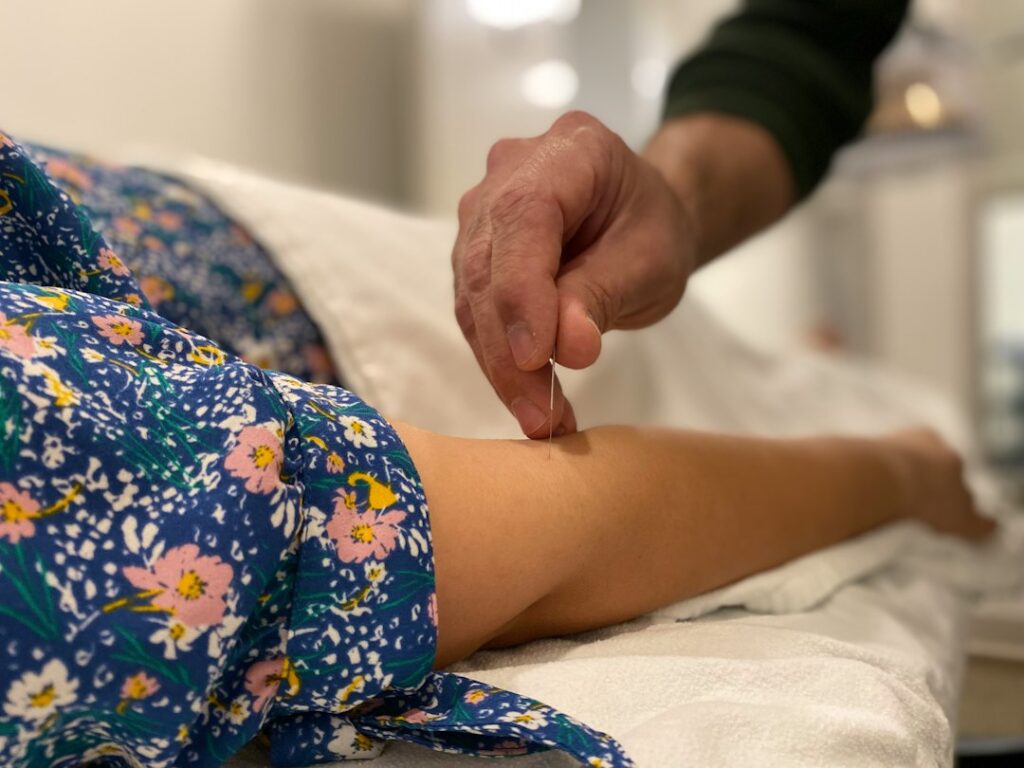
- Acupuncture. Fine needles placed at set points, sometimes with a mild electric current.
- Moxibustion. Warming points on the skin with a burning herb called mugwort.
- Diet and lifestyle advice. Warm, cooked, regular meals and calm eating.
Do Chinese herbs work for IBS?
Some formulas have helped in trials, but the results are mixed and the evidence is weak. No single formula has strong proof.
The best-known trial came from Australia and appeared in JAMA in 1998. It split 116 adults with IBS into 3 groups for 16 weeks. They took a standard herbal formula, a formula tailored to each person, or a placebo. Both herbal groups improved more than placebo, and the tailored formulas were no better than the standard one. Fourteen weeks after treatment ended, only the tailored group kept its gains.
Later trials were less clear.
- Hong Kong, 2006. In 119 people with IBS with diarrhoea, an 11-herb formula did no better than placebo. Global improvement came for 35% on herbs and 44.1% on placebo after 8 weeks.
- Australia, 2015. In 125 people with IBS with constipation, a 7-herb formula eased straining and hard stools over 8 weeks. It did not ease belly pain.
- Beijing, 2025. In 96 people with IBS with diarrhoea, the classic formula Tongxie Yaofang helped 79.2%. Placebo helped 70.8%, which was not a real difference.
A 2026 review in Phytotherapy Research pooled 7 Chinese herbal trials. Herbs beat placebo by a fair margin, about as well as peppermint oil for IBS did in the same review. The authors still said the quality of many studies was limited.
Why does placebo work so well in herbal trials?
Because IBS responds strongly to care, hope and time. A 2024 review of 24 herbal IBS studies with 2,596 people found that 37% improved on a herbal placebo.
That is why trials need a placebo group. Without one, a herb that helps 70% of people looks amazing. With one, as in the 2025 Beijing trial, you see that most of that help would have come anyway. This does not make the relief less real. It means the herb itself may add less than people think.
Does acupuncture work for IBS?
Acupuncture has better evidence than Chinese herbs, though it still has limits. Recent trials suggest it helps more than fake needling.
The 2025 ACTION trial ran in 6 hospitals in China. People with IBS with diarrhoea had 15 sessions over 6 weeks. Real acupuncture helped 57.9%, against 41.4% with sham needles. The benefit started by week 3 and lasted to 18 weeks. No serious side effects were reported.
A 2026 review in Gastroenterology pooled 12 trials with 1,105 people. Acupuncture helped more people than sham needling, with about 1.6 times the response rate. The authors rated the certainty as low, because the trials differed a lot.
In the UK, a 2012 trial tested acupuncture in family practice with 233 people. Those offered up to 10 weekly sessions on top of usual care did better at 3 months. Success came for 49% against 31% with usual care alone. The benefit largely held for a year. By 2 years, the gap was smaller and no longer clear.
Does moxibustion help IBS?
Possibly, but the evidence is weak. A 2026 review of 22 trials ranked moxibustion highly for overall response in IBS with diarrhoea. The authors had low or very low confidence in many of their estimates.
Most moxibustion trials are small, come from one country and are hard to blind. Burns are the main risk, so only use it with a trained practitioner.
How could TCM affect the gut?
Early research points to the gut microbiome and the nerves of the gut, but most of it is in animals.
I strongly believe gut health plays a major role in nearly every health condition. So this rat study caught my eye. In 2024, researchers gave Tongxie Yaofang to rats with an IBS-like gut. It eased gut pain and diarrhoea. When the rats’ gut bacteria were wiped out first, the formula stopped working.
The formula seemed to boost bacteria that handle bile acids, which in turn calmed gut nerves. That is a fascinating gut angle. Rats are not people, though, and the human trial of the same formula did not beat placebo.
Acupuncture may act on the gut-brain axis through nerve signals and calmer pain processing. Brain-gut therapies such as hypnotherapy for IBS work on the same loop, with stronger evidence.
Is TCM for IBS safe?
Acupuncture by a trained, licensed practitioner is generally safe. Chinese herbs carry real risks, mainly to the liver and from product quality.
- Liver injury. A study looked at 25,927 hospital cases of drug-induced liver injury in mainland China. TCM, herbal and dietary supplements were the top cause, at 26.81%.
- Hidden ingredients. An Australian lab tested 26 TCM products. Half contained an undeclared medicine, such as warfarin or paracetamol. Some contained arsenic, lead or cadmium, and 92% had some form of contamination or swap.
- Medicine clashes. Some herbs can change how your medicines work, including blood thinners. Always check with a pharmacist.
- Acupuncture risks. Minor bruising or soreness can happen. The 2025 ACTION trial reported no serious side effects in 280 people.
A 2026 review of liver injury warns that herbal and dietary supplements are a growing cause around the world. Natural does not mean safe.
How can you try TCM for IBS safely?
Get your IBS confirmed by a doctor first, then use TCM alongside proven care, not in place of it.
Try this.
- Start with acupuncture. It has the best evidence in the TCM toolkit and fewer safety concerns than herbs.
- Choose a licensed practitioner. Ask about their training, registration and use of single-use needles.
- Plan for 10 to 15 sessions. Trials used 10 to 15 sessions over 6 to 10 weeks, so give it a fair test.
- Buy herbs only from regulated sources. Avoid unlabelled powders and online products with big promises.
- Tell your doctor and pharmacist. Share every herb you take, especially if you take other medicines.
- Get your liver checked. If you take herbs for more than a few weeks, ask your doctor about liver blood tests.
- Keep a symptom diary. Rate pain, bloating and stools each week to see if TCM really helps you.
- Keep the basics going. Regular meals, soluble fibre and a short low FODMAP diet in 3 phases have stronger evidence.
TCM shares a lot with global traditional Ayurveda, which also centres health on digestion. My guide to Ayurveda for IBS grades those herbs in the same honest way.
When should you see a doctor?
See a doctor before you start TCM, so other illnesses can be ruled out. Acupuncture can ease symptoms, so it should never hide a different problem.
Stop herbs and see a doctor quickly if you notice yellow skin or eyes, dark urine or pain under your right ribs. Get checked too if you see blood in your stool or lose weight without trying, such as 3 kg (about 7 lb) or more.
Frequently asked questions
Which is better for IBS, acupuncture or Chinese herbs?
Acupuncture has stronger and more recent evidence. Large trials and a 2026 review found it beat sham needling. Herbal trials are mixed, and herbs carry more safety risks. If you want to try TCM, acupuncture is the safer first choice.
How many acupuncture sessions do I need for IBS?
Most trials used 10 to 15 sessions over 6 to 10 weeks. In the 2025 ACTION trial, the benefit showed by week 3. If you feel no change after about 8 sessions, talk to your practitioner about whether to continue.
Is Tongxie Yaofang good for IBS with diarrhoea?
It is the classic TCM formula for IBS with diarrhoea, but the latest trial did not show it beats placebo. In 96 people, 79.2% improved on the formula and 70.8% on placebo. Larger trials are needed before I could recommend it.
Can I use TCM with my IBS medicines?
Acupuncture is usually fine alongside medicines. Herbs can interact with many medicines, so always check with your doctor or pharmacist first. Never stop a prescribed medicine because you started TCM.
Is TCM safe in pregnancy?
Many Chinese herbs are not tested in pregnancy, so avoid them unless your doctor agrees. Some acupuncture points are avoided in pregnancy too. Only see a practitioner trained in pregnancy care, and tell your midwife or doctor.
What I want you to remember
TCM for IBS has some real promise, mostly for acupuncture. Chinese herbs have mixed results, a large placebo effect and real safety risks. Neither is a first-line IBS treatment, but acupuncture can be a sensible extra when the basics are not enough.
Check what you know in the Daily Myth game. Then join my free 30-Day Calm Gut Challenge to build calm daily habits that support your gut-brain loop.
Sources
- Yang JW, et al. Efficacy of acupuncture in irritable bowel syndrome (ACTION). A multicenter randomized controlled trial. Gastroenterology, 2025
- Zheng HZ, et al. Acupuncture versus sham non-acupoint acupuncture for irritable bowel syndrome. A systematic review and meta-analysis. Gastroenterology, 2026
- MacPherson H, et al. Acupuncture for irritable bowel syndrome. Primary care based pragmatic randomised controlled trial. BMC Gastroenterology, 2012
- MacPherson H, et al. Acupuncture for irritable bowel syndrome. 2-year follow-up of a randomised controlled trial. Acupuncture in Medicine, 2017
- Bensoussan A, et al. Treatment of irritable bowel syndrome with Chinese herbal medicine. A randomized controlled trial. JAMA, 1998
- Leung WK, et al. Treatment of diarrhea-predominant irritable bowel syndrome with traditional Chinese herbal medicine. A randomized placebo-controlled trial. American Journal of Gastroenterology, 2006
- Bensoussan A, et al. Efficacy of a Chinese herbal medicine in providing adequate relief of constipation-predominant irritable bowel syndrome. A randomized controlled trial. Clinical Gastroenterology and Hepatology, 2015
- Liang SB, et al. Chinese herbal formula Tongxie Yaofang granules for diarrhoea-predominant irritable bowel syndrome. A randomised, double-blind, placebo-controlled, phase II trial. BMJ Open, 2025
- Meyer A, et al. Systematic review and meta-analysis. Plant-based therapy for irritable bowel syndrome. Phytotherapy Research, 2026
- Huang K, et al. Herbal placebo response in clinical trials on irritable bowel syndrome. A systematic review and meta-analysis. Frontiers in Pharmacology, 2024
- Zhang J, et al. Comparative efficacy and safety of Chinese medicine external therapies for diarrhea-predominant irritable bowel syndrome. A systematic review and network meta-analysis. Frontiers in Medicine, 2026
- Jia F, et al. Tong-Xie-Yao-Fang strengthens intestinal feedback control of bile acid synthesis to ameliorate irritable bowel syndrome. Journal of Ethnopharmacology, 2024
- Shen T, et al. Incidence and etiology of drug-induced liver injury in mainland China. Gastroenterology, 2019
- Coghlan ML, et al. Combined DNA, toxicological and heavy metal analyses provides an auditing toolkit to improve pharmacovigilance of traditional Chinese medicine. Scientific Reports, 2015
- Björnsson ES, Andrade RJ. An update on drug-induced liver injury. What's new? Journal of Internal Medicine, 2026
- Lacy BE, et al. ACG clinical guideline. Management of irritable bowel syndrome. American Journal of Gastroenterology, 2021
- Vasant DH, et al. British Society of Gastroenterology guidelines on the management of irritable bowel syndrome. Gut, 2021
This article shares general information. It is not a diagnosis or a treatment plan. Please talk to your own doctor before you change your diet, medicines or supplements.

Dt. Hashika Vyas
Hashika is a dietitian who works with clients in 15+ countries on gut health, PCOS and weight. She healed her own IBS, and writes every guide on this site to be calm, clear and practical.