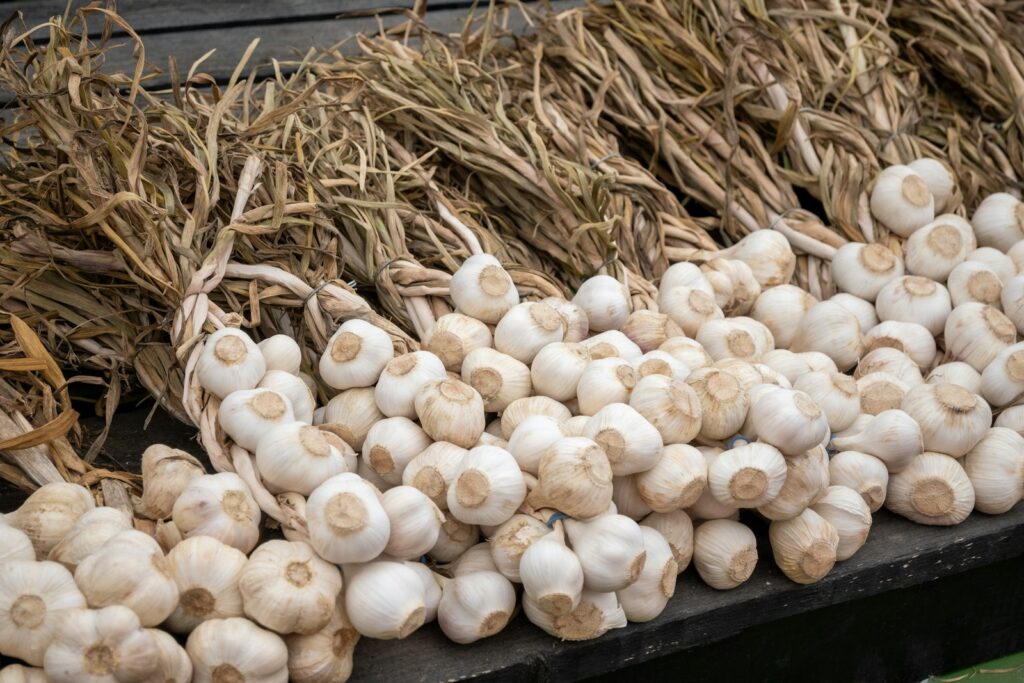
No, garlic is high FODMAP. It is rich in fructans, the most common IBS trigger in recent trials, so even a small amount can cause bloating and pain. Garlic-infused oil is low FODMAP, because fructans do not dissolve in oil. Chives, spring onion greens and asafoetida also add flavour without the fructans.
In this article
- Is garlic low FODMAP?
- Why does garlic cause bloating and pain?
- How common is a garlic or fructan trigger?
- Is it the garlic or the gluten?
- Does cooking garlic remove the FODMAPs?
- What can I use instead of garlic?
- Is garlic good for gut health?
- Can I eat garlic again one day?
- Frequently asked questions
- What I want you to remember
Garlic is the trigger my clients miss most. It hides in pasta sauce, soup, curry paste, salad dressing, stock cubes and spice mixes. Many people with IBS cut out wheat or dairy for months and still feel bloated, because this was the real culprit.
So is garlic low FODMAP? Sadly, no. But you do not have to give up its flavour. Here is what the science says, why it upsets a sensitive gut and the swaps I use in my own kitchen.
Is garlic low FODMAP?
No, garlic is high FODMAP. It is rich in fructans, a type of fermentable carbohydrate that your small intestine cannot digest. Monash University, the team that created the low FODMAP diet, lists garlic and onion as high in fructans.
A Monash lab study measured fructans in 60 vegetables. Garlic was among the richest sources, along with artichoke, shallots, leek bulb and onion. These vegetables held between 1.2 and 17.4 g of fructans per 100 g, about 3.5 ounces.
Because it is so concentrated, even a small amount can bother a sensitive gut. Garlic powder and garlic salt are made from the dried bulb, so they contain fructans too.
Why does garlic cause bloating and pain?
Fructans travel through your small intestine and your body does not absorb them. When they reach your colon, gut bacteria ferment them and make gas. That is normal for everyone. The difference in IBS is how the gut feels it.
A 2017 UK trial used MRI scans to watch this happen. Twenty-nine people with IBS and 29 healthy people drank inulin, a type of fructan, on one day and plain glucose on another.
Inulin filled the colon with gas in both groups. But 13 of the 29 people with IBS had clear symptoms after inulin, compared with 6 after glucose. The healthy people had a similar amount of gas but fewer symptoms.
So the problem is not too much gas. It is a gut that is extra sensitive to stretching. That is why calming the gut and brain matters as much as the food itself.
How common is a garlic or fructan trigger?
Fructans are the most common FODMAP trigger in recent research. In a 2024 Belgian trial, 117 people with IBS tested hidden FODMAP powders one at a time. Fructans brought symptoms back in 56% of them, more than any other group.
A smaller 2025 US trial of 21 people found something similar. When fructans and galacto-oligosaccharides came back into the diet, belly pain got worse.
But that also means many people with IBS do tolerate fructans. Your own reaction is the only one that counts, which is why testing matters.
Is it the garlic or the gluten?
Often it is the fructans, not the gluten. Wheat is another big fructan source, so people who react to garlic often blame bread.
A 2018 Norwegian trial tested 59 people who believed they were sensitive to gluten. Without knowing which was which, they ate muesli bars containing gluten, fructans or neither, for a week each.
Fructans caused more bloating and overall symptoms than gluten. Gluten caused no more symptoms than the dummy bars. If both foods bother you, fructans may be the link. Please test for coeliac disease with your doctor before cutting out gluten.
Does cooking garlic remove the FODMAPs?
Not in water. Fructans dissolve in water, so they leak into soups, stews and sauces. Monash explains that adding a whole clove to a soup and removing it later does not work.
Oil is different. Fructans do not dissolve in fat, but the flavour does. That is the clever science behind infused oil.
What can I use instead of garlic?
You have more options than you think. Here are the swaps I use most with clients.
Garlic-infused oil
This is the closest match to the real flavour. Monash notes that garlic-infused oil is low FODMAP because fructans are not fat soluble. Look for oils with the Monash low FODMAP certification logo, which have been lab tested.
Try this. Warm 2 tablespoons of olive oil in a pan. Add 2 or 3 peeled garlic cloves, whole or halved, not crushed. Cook gently for 1 to 2 minutes, then remove and discard every piece. Use the oil straight away to start your dish.
A food safety note. Garlic stored in oil can grow the bacteria that cause botulism, a rare but serious illness. University of Missouri food safety experts advise refrigerating homemade garlic oil right away and using it within 4 days. Never keep it at room temperature. When in doubt, make a fresh small batch each time.
Other flavour swaps
- Chives, fresh or dried, for a mild garlic and onion flavour
- The green tops of spring onions, sliced, without the white bulb
- Asafoetida, a strong spice used in many traditional kitchens. A tiny pinch fried in oil tastes like garlic and onion. Some brands blend it with wheat flour, so check the label.
- Fresh ginger, cumin and herbs like basil, parsley and thyme, plus lemon zest to brighten a dish
Global traditional Ayurveda has cooked this way for centuries. A sattvic kitchen skips onion and garlic and builds flavour with spices, herbs and fresh ingredients. Many of my clients find these meals calming, and the science now explains why.
Can you spot garlic hiding in everyday foods? Try the Trigger or Safe game, then feed a happy belly in Feed the Tummy.
Is garlic good for gut health?
For people without IBS, it can be very good for the gut. I strongly believe gut health plays a major role in nearly every health condition, and fructans are one way plants feed our gut bacteria.
In a 2018 Australian trial, 49 adults with high blood pressure took aged garlic extract or a dummy pill for 12 weeks. The garlic group had richer, more varied gut bacteria, with more Lactobacillus and Clostridia. Their blood pressure also dropped. This was a small trial of a supplement, not garlic in food, so the results need larger studies.
Cutting fructans has a cost too. In a 2021 UK analysis, people on a low FODMAP diet had less Bifidobacterium, a friendly bacteria, than people on a sham diet. Experts see no known harm from this short-term drop, but it is one reason I never keep clients off garlic longer than needed.
One warning. A 2022 review linked garlic supplements with a higher risk of bleeding during surgery. If you take blood thinners or have surgery coming up, talk to your doctor before using them.
Can I eat garlic again one day?
Many people can, at least in small amounts. The low FODMAP diet is a short test, not a forever diet. After 2 to 6 weeks of strict eating, you bring each FODMAP group back to see what your gut can handle.
Try this. Once your symptoms have settled, test it on its own. On day 1, cook a quarter of a clove into a meal. On day 2, try half a clove. On day 3, try a whole clove. Keep the rest of your food low FODMAP and write down how you feel. If symptoms return, stop and wait until you feel normal before your next test.
My full IBS diet guide shows how to plan the whole reintroduction step by step. If you are in the middle of a flare, start with my guide on how to calm an IBS flare-up.
Frequently asked questions
Is garlic-infused oil low FODMAP?
Yes. Fructans dissolve in water but not in oil, so the oil takes on the flavour without the fructans. Choose a certified low FODMAP brand, or make a fresh batch, remove every piece, refrigerate it and use it within 4 days.
Is garlic powder low FODMAP?
No. It is simply the dried bulb, so it still contains fructans. It hides in many spice mixes, stock cubes, crackers, sauces and ready meals, so check ingredient lists carefully.
Are chives low FODMAP?
Yes. Monash suggests chives and the green tops of spring onions as easy swaps for onion. Many people use them in place of garlic too. They need less cooking time, so add them near the end for the best flavour.
Does roasted or cooked garlic have fewer FODMAPs?
Cooking does not destroy fructans. In soups and stews they move into the liquid, so removing the cloves later does not help. Only cloves cooked briefly in oil and then removed leave a low FODMAP result.
Why does garlic upset me when I do not have IBS?
Everyone ferments fructans and makes some gas, and most people do not notice it. A sensitive gut or a large serving can make it uncomfortable. If it regularly causes pain or changes in your stool, see a doctor.
What I want you to remember
Garlic is high FODMAP because fructans, the most common IBS trigger in recent trials, fill every clove. During the strict phase, swap it for garlic-infused oil, chives, spring onion greens and spices. Then test it again, because many people can enjoy some later.
Flavour and a calm gut can go together. I promise your food does not have to be boring.
For a calmer gut every day, join my free 30-Day Calm Gut Challenge.
Sources
- Muir JG, et al. Fructan and free fructose content of common Australian vegetables and fruit. Journal of Agricultural and Food Chemistry, 2007
- Monash University FODMAP. All about onion, garlic and infused oils on the low FODMAP diet, 2023
- Monash University FODMAP. Cooking with onion and garlic. Myths and facts, 2015
- Major G, et al. Colon hypersensitivity to distension, rather than excessive gas production, produces carbohydrate-related symptoms in IBS. Gastroenterology, 2017
- Van den Houte K, et al. Efficacy and findings of a blinded randomized reintroduction phase for the low FODMAP diet in IBS. Gastroenterology, 2024
- Eswaran S, et al. All FODMAPs aren't created equal. A randomized reintroduction trial in IBS. Clinical Gastroenterology and Hepatology, 2025
- Skodje GI, et al. Fructan, rather than gluten, induces symptoms in patients with self-reported non-celiac gluten sensitivity. Gastroenterology, 2018
- University of Missouri Extension. Garlic-infused oil (N5001)
- Ried K, et al. The effect of Kyolic aged garlic extract on gut microbiota, inflammation and cardiovascular markers. The GarGIC trial. Frontiers in Nutrition, 2018
- Staudacher HM, et al. Gut microbiota associations with diet in IBS and the effect of low FODMAP diet and probiotics. Clinical Nutrition, 2021
- Gibson PR, et al. FODMAPs, prebiotics and gut health. The FODMAP hypothesis revisited. Alimentary Pharmacology and Therapeutics, 2020
- Hatfield J, et al. Dietary supplements and bleeding. Baylor University Medical Center Proceedings, 2022
This article shares general information. It is not a diagnosis or a treatment plan. Please talk to your own doctor before you change your diet, medicines or supplements.

Dt. Hashika Vyas
Hashika is a dietitian who works with clients in 15+ countries on gut health, PCOS and weight. She healed her own IBS, and writes every guide on this site to be calm, clear and practical.