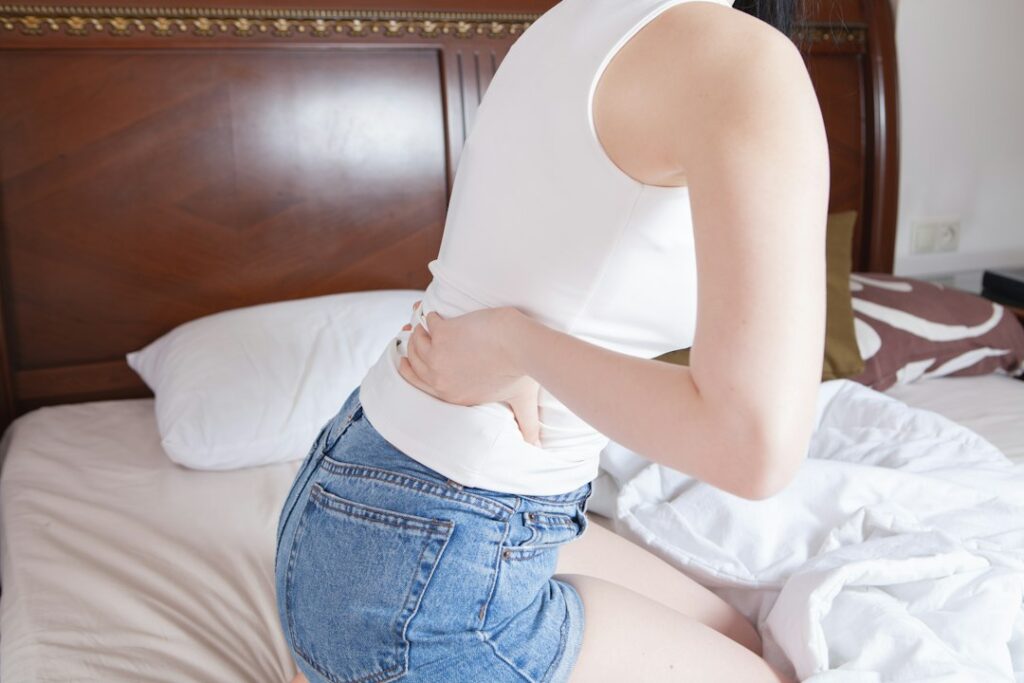
IBS often gets worse just before and during your period because oestrogen and progesterone fall sharply, which makes the gut more sensitive. Pain, bloating and diarrhoea are most common. Track your cycle for 2 to 3 months, eat your safe foods before your period, and use heat, gentle movement and slow breathing to ease symptoms.
In this article
- Why are IBS and periods linked?
- What IBS symptoms change with your cycle?
- Is it IBS, period pain or both?
- How are your hormones, gut and microbiome connected?
- What helps IBS during your period?
- Can ginger or omega-3 ease period pain?
- Does the pill or hormone treatment help IBS?
- When should you see a doctor?
- Frequently asked questions
- What I want you to remember
If your IBS gets worse around your period, you are not imagining it. A 2014 survey looked at 156 healthy women with no gut disease at all. 73% had at least one gut symptom just before or during their period. Belly pain and diarrhoea were the most common.
Now add IBS to the picture. IBS and periods are closely linked. A sensitive gut and a monthly drop in hormones can make the days around your period the hardest of the month. Many women have been told it is “just your period” or “just your IBS”. Often it is both, and both can be eased.
This guide explains the link between IBS and periods, what the research shows and the simple steps that help. It also covers the warning signs that mean something else could be going on.
Why are IBS and periods linked?
IBS and periods are linked mainly through the fall in hormones just before and during your period. Oestrogen and progesterone drop sharply at this time, and these hormones affect how your gut moves and how much it feels.
A 2009 review from the University of Washington looked at why gut symptoms rise around menses and around early menopause. Both are times when ovarian hormones are low or falling. The authors suggest this hormone withdrawal plays a part. One study in the review found that women with IBS felt gut pain more strongly during their period than at other times of the month.
A 2014 review in the World Journal of Gastroenterology explains how sex hormones act along the gut and brain link. They can change gut sensitivity, gut movement, the gut lining and immune activity in the gut wall. That is a lot of levers, and they all shift during your cycle.
There is a second player too. Your womb makes chemicals called prostaglandins before your period. A 2024 review notes that prostaglandins make the womb muscle squeeze, which causes period cramps. The womb and the bowel sit very close together, so cramps and bowel pain can be hard to tell apart.
What the bigger studies show
- 13 studies, one pattern. A 2010 review found that women with IBS and healthy women both reported more IBS symptoms during their period than at other phases.
- 26 countries. The 2025 Rome Foundation global survey included 14,570 people with gut disorders. IBS was one of the 2 conditions with the most period-related symptoms.
- Your cycle phase matters. In a 2021 study of 102 women with IBS, symptoms were strongest during the period itself. Constipation was more common in the week or two before it. More than half had bloating in every phase.
What IBS symptoms change with your cycle?
Belly pain, bloating, diarrhoea and constipation are the symptoms that change most. The pattern often follows the phase of your cycle.
- The week or two before your period. Progesterone is higher here. Many women notice more constipation and a heavier, bloated belly.
- The days just before and during your period. Hormones fall fast. Pain, cramping and looser, more urgent stools are more common.
- After your period. For many women, the gut settles in the days after bleeding stops.
Your pattern may look different, and that is normal. The 2014 survey of healthy women found another link. Women with low mood or anxiety around their period were more likely to have 2 or more gut symptoms. Tiredness was also strongly linked. The authors suggest the brain, gut and hormones share the same pathways.
If worry and gut symptoms feed each other for you, read my guide on IBS and anxiety. It explains the gut and brain loop and how to calm it.
Is it IBS, period pain or both?
It can be both, and the overlap is bigger than most people think. Period cramps and IBS pain sit in the same part of the body and can feel very alike.
A 2026 study of 3,336 girls aged 10 to 16 in Colombia found something striking. Among the girls whose answers met the criteria for IBS, 62% had their belly pain and bowel changes only during their period. The researchers warn that period-related gut symptoms can look like IBS on a questionnaire.
This matters for you as an adult too. If your symptoms appear only during your period and vanish the rest of the month, tell your doctor. That pattern may point to period-related gut symptoms rather than IBS, or to another cause such as endometriosis.
Could it be endometriosis?
Endometriosis is a condition where tissue like the lining of the womb grows outside it. It often causes painful periods and gut symptoms, and it is easy to mistake for IBS.
A 2022 meta-analysis pooled 11 studies with over 96,000 women. Women with endometriosis had about 3 times higher odds of IBS than women without it. About 1 in 4 women with endometriosis also had IBS. A 2021 meta-analysis from Milan found a similar link, with about 3 times higher odds.
A 2023 review from Berlin describes “endo belly”. This is bloating that builds in the second half of the cycle and peaks before the period. Women with endometriosis also seem to feel stretching in the bowel wall more easily.
Can diet help? A 2026 review found only 5 studies on the low FODMAP diet in endometriosis. Together they suggest it can ease gut symptoms such as pain, bloating and constipation. The studies were few and small, so it is best done with a dietitian.
See your doctor or gynaecologist if your periods are very painful or pain stops you from working or studying. Painful sex, or pain when passing stool during your period, also needs a check. These can be signs of endometriosis.
How are your hormones, gut and microbiome connected?
I strongly believe your gut sits at the centre of how your whole body feels, and your cycle is no exception. The research on hormones and gut bacteria is still young, but it points the same way.
The 2014 review on sex hormones and IBS describes an emerging idea called the “microgenderome”. It suggests that sex hormones and your gut bacteria influence each other. Hormones also shape your stress response, and stress is one of the best known IBS triggers.
Most of this work comes from animal studies and small human studies, so we cannot yet say exactly how it works. What we can say is that a calmer, well-fed gut tends to cope better with each monthly hormone shift. That is where food and daily habits come in.
What helps IBS during your period?
Planning ahead helps most. The goal is to be at your gentlest with your gut in the days before your period, not to wait until the pain starts.
1. Track your cycle and your gut
Note your cycle day, your stool type, pain and bloating every day for 2 to 3 cycles. A simple notes app works. You will soon see your own pattern, and you can plan around it.
Try this. Mark the 3 to 5 days before your period as your “gentle gut days” in your calendar. Plan simple meals, more rest and fewer big events on those days when you can.
2. Stick to your safe foods before your period
If you already know your trigger foods, the days before your period are a good time to avoid them. Your gut may be more sensitive then, so a food you handle well mid-cycle may bother you now.
- Choose low FODMAP basics you know suit you, such as rice, oats, potatoes, eggs, firm tofu, lactose-free yogurt, carrots, courgette and kiwi.
- Eat regular, smaller meals instead of one large one.
- Go easy on very fatty or spicy meals if they usually speed up your gut.
New to FODMAPs? Start with my complete IBS diet guide, which explains how to find your own triggers step by step.
3. Match your food to your symptom
If you get looser stools during your period, my IBS with diarrhoea guide has gentle foods and swaps. If you get more constipated in the week before, my IBS constipation guide covers kiwi, psyllium and fluids. For a heavy, puffy belly, see my guide to bloating causes and fixes.
4. Use heat
Heat is one of the best tested home remedies for period pain. A 2026 meta-analysis pooled 57 trials with 5,359 women. Heat reduced period pain compared with no treatment. It worked about as well as common anti-inflammatory painkillers, with fewer side effects.
Try this. Place a warm (not hot) water bottle or heat pad on your lower belly for 20 to 30 minutes. Wrap it in a towel to protect your skin. Many women with IBS find it eases gut cramps too.
5. Keep moving
Gentle movement helps period pain, and it helps IBS too. A 2026 meta-analysis of 29 trials with 1,704 women found exercise reduced period pain and symptom severity. Stretching and mind-body exercise such as yoga helped symptom severity most. The certainty of the evidence was low, so think of this as helpful, not a cure.
Try this. On your gentle gut days, take a 15 to 20 minute walk after meals, or try 10 minutes of slow stretching before bed.
6. Calm your nervous system
Stress makes both period pain and IBS feel louder. Slow breathing with a longer out-breath is a simple way to calm your body. You can practise with my free Breathe With Me game, which guides your breath with soft music.
If you want a daily habit, join the free 30-Day Calm Gut Challenge. You get one small, calming step in your inbox each day.
Can ginger or omega-3 ease period pain?
Both have some evidence for period pain, though the studies have limits. Neither has been tested in women with IBS specifically.
- Ginger. A 2024 meta-analysis found ginger reduced period pain more than a placebo. In the studies that compared them, it worked about as well as anti-inflammatory painkillers. Many studies had a high risk of bias, and safety was rarely reported. Ginger is also low FODMAP, so fresh ginger tea is a gentle option for most people with IBS.
- Omega-3 fats. A 2024 review looked at 12 studies with 881 women. Taking 300 to 1,800 mg of omega-3 a day for 2 to 3 months reduced period pain and painkiller use. Most studies were of neutral quality. Oily fish such as salmon, sardines and mackerel are natural sources.
Safety note. Talk to your doctor before taking ginger or fish oil supplements if you take blood thinners, are pregnant or have a bleeding disorder. Food amounts, like ginger in tea or fish twice a week, are a gentler place to start.
What about period painkillers?
Anti-inflammatory painkillers such as ibuprofen block prostaglandins, and a 2024 review lists them as the first-line treatment for period pain. They can upset some stomachs, so take them with food. Ask your doctor or pharmacist which pain relief suits you, especially if you have other gut problems.
Does the pill or hormone treatment help IBS?
We do not know yet. A 2010 review found there was not enough data to say how hormone treatment affects IBS symptoms. Some women feel better on hormonal contraception and some feel worse.
If you are thinking about hormonal options for painful or heavy periods, discuss your gut symptoms with your doctor too. Never stop or change prescribed hormones without medical advice.
When should you see a doctor?
See a doctor if your symptoms are new, getting worse or do not fit your usual pattern. IBS should be diagnosed by a doctor, because other conditions can look the same.
- Bleeding from your bottom, or black, tarry stools
- Losing weight without trying, even a few kilograms (several pounds)
- Very painful periods, pain during sex or pain when passing stool during your period
- Bleeding between periods or after sex
- Heavy periods with tiredness, breathlessness or pale skin
- Diarrhoea that wakes you at night
- Symptoms that start after age 50, or a recent change in your bowel habit
Frequently asked questions
Can your period cause IBS flare-ups?
Yes, your period can trigger IBS flare-ups for many women. Hormones fall sharply before and during your period, and this seems to make the gut more sensitive. A 2010 review of 13 studies found IBS symptoms rose during menses in both women with IBS and healthy women.
Why do I get diarrhoea on my period?
Period diarrhoea is very common, even without IBS. In a 2014 survey of healthy women, 28% had diarrhoea during their period. Falling hormones and chemicals called prostaglandins are both thought to play a part. If you also have IBS, the effect can be stronger.
Is bloating before my period IBS or hormones?
It can be either, or both. Bloating in the week before a period is common. In a 2021 study, more than half of women with IBS were bloated in every phase of the cycle. Bloating that builds strongly before each period with very painful periods can also be a sign of endometriosis.
Does IBS get better after menopause?
The evidence is mixed. A 2025 global survey found that women before menopause reported more gut sensitivity, while women after menopause reported more leakage and pelvic floor problems. Read my guide to calming an IBS flare-up for steps that help at any age.
What should I eat during my period with IBS?
Eat simple, regular meals built on foods you already know are safe for you. Low FODMAP basics such as rice, oats, potatoes, eggs, firm tofu, carrots and kiwi suit most people with IBS. Fresh ginger tea and oily fish may help period pain as well.
What I want you to remember
The link between IBS and periods is real, common and backed by research. Your hormones and your gut talk to each other every day, and they talk loudest around your period.
Track your pattern for 2 to 3 cycles, plan gentle gut days, keep to your safe foods and use heat, movement and slow breathing. If your periods are very painful or your symptoms do not follow a clear pattern, see your doctor. You deserve answers, not just “it is your period”.
Want to see how much you know about your own gut? Try the 2 minute Gut Check quiz.
Sources
- Bernstein MT, et al. Gastrointestinal symptoms before and during menses in healthy women. BMC Women's Health, 2014
- Heitkemper MM, Chang L. Do fluctuations in ovarian hormones affect gastrointestinal symptoms in women with irritable bowel syndrome? Gender Medicine, 2009
- Mulak A, et al. Sex hormones in the modulation of irritable bowel syndrome. World Journal of Gastroenterology, 2014
- Adeyemo MA, et al. Meta-analysis. Do irritable bowel syndrome symptoms vary between men and women? Alimentary Pharmacology and Therapeutics, 2010
- Sarnoff RP, et al. Sex differences, menses-related symptoms and menopause in disorders of gut-brain interaction. Neurogastroenterology and Motility, 2025
- Pati GK, et al. Irritable bowel syndrome and the menstrual cycle. Cureus, 2021
- Arrizabalo S, et al. Menstrual-associated gastrointestinal symptoms and their impact on IBS diagnosis in adolescents. Neurogastroenterology and Motility, 2026
- Kirsch E, et al. Dysmenorrhea, a narrative review of therapeutic options. Journal of Pain Research, 2024
- Nabi MY, et al. Endometriosis and irritable bowel syndrome. A systematic review and meta-analyses. Frontiers in Medicine, 2022
- Chiaffarino F, et al. Endometriosis and irritable bowel syndrome. A systematic review and meta-analysis. Archives of Gynecology and Obstetrics, 2021
- Velho RV, et al. Endo belly. What is it and why does it happen? A narrative review. Journal of Clinical Medicine, 2023
- Watrowski R, et al. Low-FODMAP diet for gastrointestinal symptoms in endometriosis. A systematic review. Nutrients, 2026
- Yuan D, et al. Heat therapy for primary dysmenorrhea. A systematic review and meta-analysis. Frontiers in Medicine, 2026
- Arroyo-Fernandez R, et al. Effectiveness of therapeutic exercise in reducing the severity of primary dysmenorrhea and associated symptoms. A systematic review and meta-analysis. Journal of Clinical Medicine, 2026
- Moshfeghinia R, et al. Ginger for pain management in primary dysmenorrhea. A systematic review and meta-analysis. Journal of Integrative and Complementary Medicine, 2024
- Snipe RMJ, et al. Omega-3 long chain polyunsaturated fatty acids as a potential treatment for reducing dysmenorrhoea pain. Systematic literature review and meta-analysis. Nutrition and Dietetics, 2024
This article shares general information. It is not a diagnosis or a treatment plan. Please talk to your own doctor before you change your diet, medicines or supplements.

Dt. Hashika Vyas
Hashika is a dietitian who works with clients in 15+ countries on gut health, PCOS and weight. She healed her own IBS, and writes every guide on this site to be calm, clear and practical.