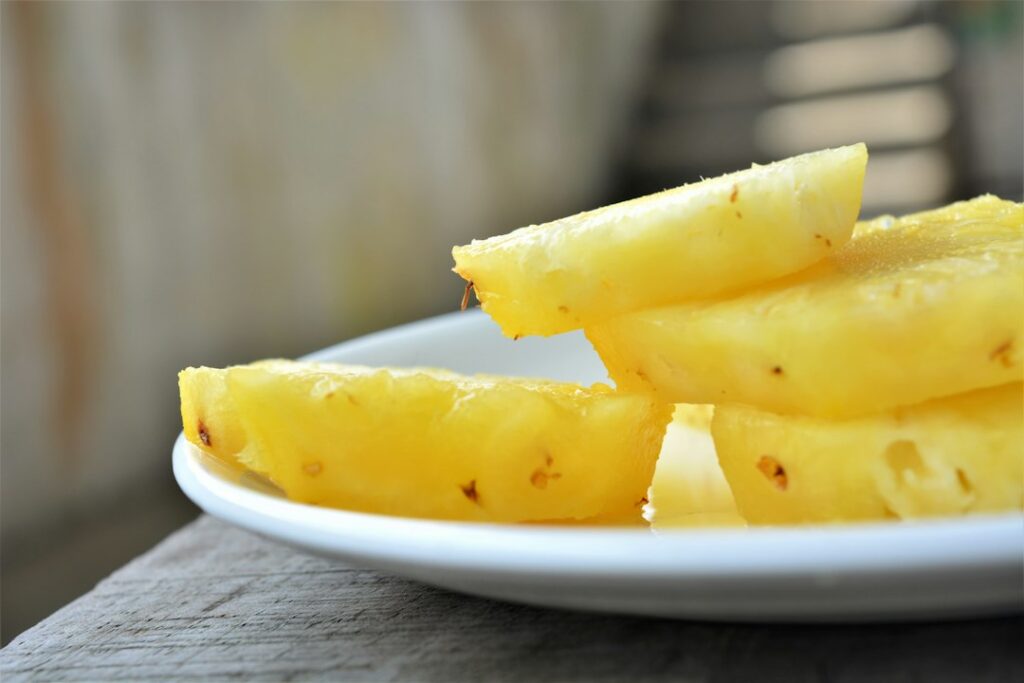
Yes, fresh pineapple is low FODMAP. Reports of Monash University testing list 140 g (about 5 oz), roughly one cup, as a low FODMAP serve. Larger portions contain fructans. Canned pineapple is low at a smaller serve, about 97 g in juice. Avoid dried pineapple at first, because a 25 g portion is already moderate.
In this article
Fresh pineapple is one of the most generous fruits on a low FODMAP diet. Yet dried pineapple can cause trouble in just a small handful. Same fruit, very different result, and it all comes down to fructans.
So is pineapple low FODMAP? Yes, fresh pineapple is low FODMAP in a normal serve of about one cup. In this guide I explain safe portions of fresh, canned and dried pineapple. I also cover what bromelain does and how pineapple fits a gut-friendly plate.
Is pineapple low FODMAP?
Yes, fresh pineapple is low FODMAP. Monash University, the team that created the low FODMAP diet, lists pineapple among its low FODMAP fruits. Its 2021 snack guide names pineapple as an easy fruit snack too.
Karlijn’s Kitchen, a dietitian site that reports Monash app results, lists fresh pineapple as low FODMAP at 140 g (about 5 oz). That is roughly one cup of chunks.
Monash updates its figures over time and keeps exact serve sizes in its app, not on its public pages. Please check the Monash app for the latest amount.
How much pineapple can you eat with IBS?
Keep fresh pineapple to about 140 g (5 oz) per sitting during the first stage of the diet. By the same source, a serve of 200 g (7 oz), about 1¼ cups, contains a moderate amount of fructans.
Fructans are chains of sugar that your gut cannot break down. Gut bacteria ferment them, which can cause gas, bloating and pain in people with IBS. They are the same FODMAP found in wheat, onion and garlic.
Fructans are also the most common IBS trigger. A 2024 trial in Gastroenterology hid each FODMAP in a powder and gave them in turn to 117 people with IBS. Fructans brought back symptoms in 56% of them, more than any other FODMAP.
So keep an eye on stacking. A cup of pineapple with toast and a garlicky sauce at the same meal can add up. My guide to whether garlic is low FODMAP explains fructans in more detail.
Is canned pineapple low FODMAP?
Yes, but the serve is smaller than fresh. Karlijn’s Kitchen reports Monash app results of 97 g (about 3.4 oz) for pineapple canned in juice. Pineapple canned in syrup is low FODMAP at 67 g (about 2.4 oz).
Canned fruit absorbs sugars from the liquid it sits in. Drain the juice or syrup and rinse the pieces before you eat them. Choose cans labelled in juice rather than syrup when you can.
Is dried pineapple low FODMAP?
No, avoid dried pineapple in the first stage of the diet. The same source says a 25 g (about 1 oz) portion already contains a moderate amount of fructans. At 50 g (1.8 oz) it is high.
Drying removes water, so the fructans become far more concentrated. Monash lists dried fruit in general as high FODMAP.
What about pineapple juice?
Monash’s public pages give no serve for pineapple juice. Juice packs the sugars of several pieces of fruit into one glass and loses most of the fibre. Whole pineapple is the safer and more filling choice. If you test juice later, start with a small glass.
Does pineapple help digestion?
Pineapple contains bromelain, a group of enzymes that break down protein. It is found in the stem and fruit of the pineapple plant. You may have heard that it helps digestion.
The evidence is weak. NCCIH, the US government centre for complementary health, says oral bromelain has been studied in only a small number of studies. They looked mainly at sinusitis and swelling after wisdom tooth surgery, not at IBS or digestion.
Bromelain supplements seem to be well tolerated, but the most common side effects are stomach upset and diarrhoea. NCCIH advises talking to your doctor before using them if you take any medicine. Little is known about safety in pregnancy or breastfeeding.
My view is simple. Enjoy pineapple as a fruit and skip bromelain pills unless your doctor suggests them.
Is pineapple good for your gut?
Pineapple adds fibre, vitamin C and variety to your plate. I strongly believe gut health shapes nearly every part of our health, and every different plant you eat feeds a wider range of gut bacteria.
By USDA figures, 100 g (3.5 oz) of raw pineapple has about 50 calories, 1.4 g of fibre and 48 mg of vitamin C. A one cup serve of 140 g gives about 2 g of fibre and 67 mg of vitamin C.
A 2019 Lancet review of 185 studies and 58 trials found the biggest health benefits at 25 to 29 g of fibre a day. Pineapple is not a fibre giant, but it adds to your total. I could not find a human trial on pineapple and gut bacteria, so its specific effect on the microbiome is still unknown.
Most of pineapple’s sugar is sucrose, which splits into equal parts glucose and fructose. Its free fructose and glucose are close to balanced too. That balance may help explain why fructans, not fructose, limit the pineapple portion.
How can you eat pineapple on a low FODMAP diet?
Keep each portion to about a cup and pair pineapple with other low FODMAP foods. Here are easy ideas.
- Breakfast. Pineapple chunks on lactose-free yogurt with oats and a few walnuts. My low FODMAP breakfast guide has more ideas.
- Snack. A cup of fresh pineapple with a small handful of peanuts.
- Grilled. Grilled pineapple slices with chicken or fish, rice and a lime dressing.
- Salsa. Diced pineapple, tomato, cucumber, coriander and chilli, with the green tops of spring onions in place of onion.
- Smoothie. Half a cup of pineapple with firm banana and lactose-free milk. My guide to whether bananas are low FODMAP explains banana ripeness.
Try this today. Swap a dried fruit snack for a cup of fresh pineapple and note how your gut feels. To test your food knowledge, play my Trigger or Safe game. For more fruit swaps, see my guide to whether grapes are low FODMAP, my low FODMAP snacks list and my complete IBS diet guide.
Frequently asked questions
How much pineapple is low FODMAP?
Reports of Monash testing list 140 g (about 5 oz) of fresh pineapple, roughly one cup, as a low FODMAP serve. At 200 g it contains a moderate amount of fructans. Check the Monash app for the latest figure.
Can pineapple cause bloating?
Yes, a large portion can. Pineapple contains fructans, which gut bacteria ferment into gas. A cup at a time is usually fine for people with IBS, while a big bowl or dried pineapple is more likely to cause bloating.
Is pineapple good for IBS?
Fresh pineapple is one of the easier fruits for IBS in a portion of about one cup. It is low FODMAP at that amount and adds fibre and vitamin C. Test larger portions later to find your own limit.
Does pineapple make you poop?
Pineapple has some fibre and lots of water, which can help keep stools soft. It is not a strong laxative. The bromelain in it has not been shown to treat constipation.
What I want you to remember
Fresh pineapple is low FODMAP at about one cup. Canned pineapple is low in a smaller serve, and dried pineapple is best avoided at first. Fructans are what limit the portion.
Bromelain is not a proven digestive aid, so enjoy pineapple as food, not medicine. If you want a calm, guided reset for your gut, join my free 30-Day Calm Gut Challenge.
Sources
- Monash University. High and low FODMAP foods
- Monash University. Low FODMAP snacks, 2021
- Monash University. Low FODMAP shopping list, 2025
- Karlijn's Kitchen. Is pineapple low FODMAP? Updated 2024
- USDA FoodData Central. Pineapple, raw, all varieties (SR Legacy 169124)
- NCCIH. Bromelain. Usefulness and safety. Updated 2024
- Van den Houte K, et al. Efficacy and findings of a blinded randomized reintroduction phase for the low FODMAP diet in irritable bowel syndrome. Gastroenterology, 2024
- Reynolds A, et al. Carbohydrate quality and human health. A series of systematic reviews and meta-analyses. Lancet, 2019
This article shares general information. It is not a diagnosis or a treatment plan. Please talk to your own doctor before you change your diet, medicines or supplements.

Dt. Hashika Vyas
Hashika is a dietitian who works with clients in 15+ countries on gut health, PCOS and weight. She healed her own IBS, and writes every guide on this site to be calm, clear and practical.