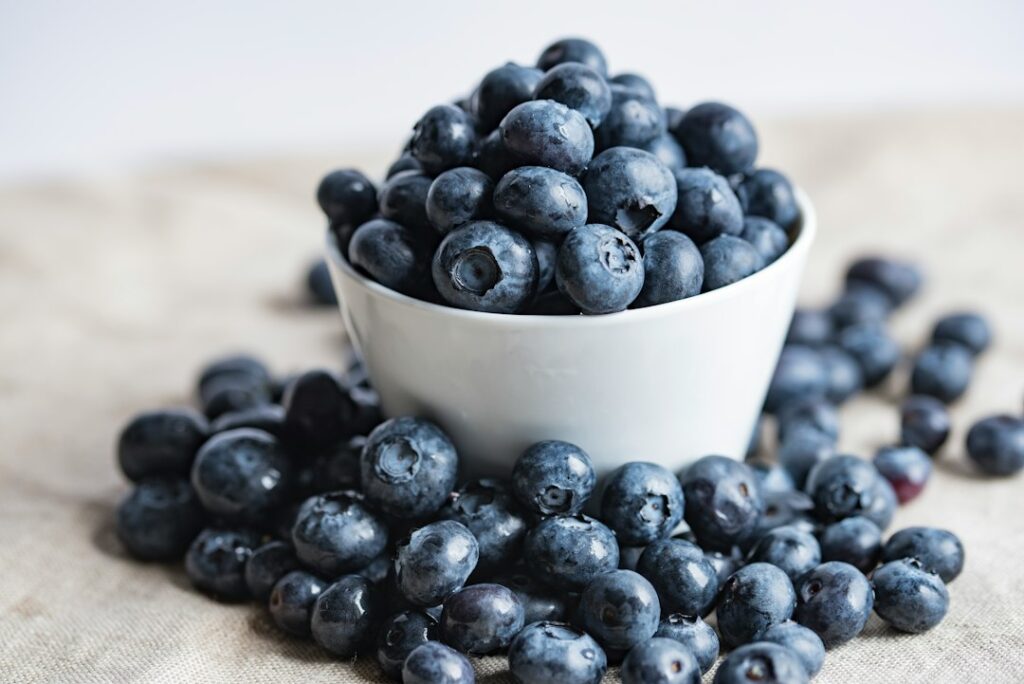
Yes, blueberries are low FODMAP. Monash University lists them as a low FODMAP fruit, and the Monash app is reported to show them low up to 500 g (about 1.1 lb). Their fructose and glucose are well balanced, so most people with IBS digest them well. Watch dried blueberries, juice and sweetened products.
In this article
In a 2023 Swiss trial, people with gut disorders took freeze-dried blueberries every day for 6 weeks. More of them got real relief from belly symptoms on blueberries than on a sugar-matched placebo. So are blueberries low FODMAP and safe for IBS? For most people, yes.
Blueberries are one of the easiest fruits for a sensitive gut. In this guide I explain why, and how much Monash has tested. I also share what the research says about your gut bacteria, and how to enjoy blueberries without a flare.
Are blueberries low FODMAP?
Yes, blueberries are low FODMAP. Monash University, the team that created the low FODMAP diet, lists blueberry as a low FODMAP fruit choice.
Karlijn’s Kitchen, a low FODMAP site that reports Monash app data, says blueberries stay low FODMAP up to 500 g (about 1.1 lb). That is far more than most people eat in one sitting. Monash serve sizes are updated in the app over time, so check the Monash app for the latest figure.
Most fruits have a much smaller low FODMAP serve. By the same source, strawberries are low up to 65 g, raspberries up to 58 g and fresh cranberries up to 90 g. Blackberries have no low FODMAP serve at all.
Why are blueberries gentle on IBS?
Blueberries are gentle because their sugars are well balanced. They hold about the same amount of fructose as glucose, so there is no excess fructose for your gut to struggle with.
By USDA figures, 100 g (3.5 oz) of raw blueberries has about 5.0 g of fructose and 4.9 g of glucose. Glucose helps your gut absorb fructose. When the two are close, most people absorb the fructose well.
Compare that with apples and pears, which carry far more fructose than glucose and also contain sorbitol. My guide to whether apples are low FODMAP explains why apples are harder for many people.
The same 100 g of blueberries gives about 57 kcal, 2.4 g of fibre, 9.7 mg of vitamin C and some vitamin K and manganese. That is a lot of goodness for a small, gentle fruit.
Is fructose a common IBS trigger?
Fructose bothers some people with IBS, but it is not the most common trigger. A 2020 review put fructose malabsorption at about 22% of people with IBS, using a breath test with a large 25 g dose.
A 2024 trial in Gastroenterology hid each FODMAP in a powder and gave them in turn to 117 people with IBS. Fructose brought back symptoms in 27% of them. Plain glucose, used as a control, did the same in 26%. Fructans triggered 56% and mannitol 54%.
So for most people, the small, balanced amount of fructose in blueberries is not a problem. The only way to know your own limit is to test it. My guide to the 3 phases of the low FODMAP diet shows how.
Can blueberries help IBS symptoms?
They may help a little, but the evidence is early. The best study so far is the 2023 Swiss trial I mentioned at the start.
It included 43 people with functional gut disorders, which include IBS. Each person took freeze-dried blueberries, equal to about 180 g (6.3 oz) of fresh berries a day, and a placebo for 6 weeks each. The placebo had the same sugars and energy.
On blueberries, 53% felt real relief from belly symptoms, compared with 30% on placebo. Quality of life and daily functioning also improved. But total symptom scores and pain scores did not change enough to be sure.
This is one small trial, and the group was mixed. I would not call blueberries a treatment. I would call them a safe, pleasant fruit that may give a small extra benefit.
Are blueberries good for your gut bacteria?
Blueberries may feed some helpful gut bacteria, though human studies are small. I strongly believe gut health shapes nearly every part of our health, and colorful plant foods are one of the easiest ways to support it.
Blueberries are rich in polyphenols called anthocyanins, which give them their deep blue color. Most of these reach the colon, where gut bacteria break them down.
In a 2011 Italian crossover study, a wild blueberry drink taken for 6 weeks raised Bifidobacterium, a helpful group of gut bacteria. A placebo drink did not. A 2026 review of berry research also linked berries with more Bifidobacterium, Akkermansia and Roseburia, but the authors called for larger human trials.
Not every study finds a clear change. In a 2026 US pilot, 18 older adults took blueberry powder, equal to about 2 cups of berries a day, for 3 months. Their main gut bacteria did not change. Only a few bacterial genes shifted.
Do blueberries help blood sugar?
Strong blueberry drinks may soften the blood sugar rise after a starchy meal. In a 2026 Leeds trial, 24 adults had a wild blueberry drink with a high carb breakfast.
Higher doses lowered the blood sugar and insulin rise in the first hour. They also raised the fullness hormones GLP-1 and PYY, though people did not feel any fuller. The drink was made from a strong berry powder, so a handful of fresh berries will likely do less.
How can you eat blueberries with IBS?
Eat a normal portion, spread your fruit across the day and pair berries with gentle foods. Here are easy ways to enjoy them.
- Start with a handful. Even though the tested serve is large, start small if your gut is very sensitive, then build up.
- Spread your fruit. Karlijn’s Kitchen suggests about 100 to 150 g (3.5 to 5.3 oz) of low FODMAP fruit per sitting. Several fruits at once can stack up fructose.
- Fresh and frozen both work. Frozen blueberries are great in porridge and smoothies, and they keep for months.
- Watch the extras. Blueberry muffins, jams and yogurts can hide wheat, honey, apple juice or inulin. Read the label.
- Be careful with dried blueberries and juice. Drying and juicing concentrate the sugars. Check the Monash app for these forms.
- Pair them well. Try blueberries on oats with lactose-free yogurt, or with a few walnuts as a snack.
Try this tomorrow. Add a handful of blueberries to your breakfast and note how your gut feels that day. My guide to a low FODMAP breakfast has more ideas, and my low FODMAP snacks guide covers the rest of the day.
Which other fruits are low FODMAP?
Many fruits are gentle on IBS in the right portion. Monash lists kiwifruit, oranges, mandarins, pineapple and cantaloupe as low FODMAP choices along with blueberries.
Firm bananas and a small handful of grapes also work for many people. My guides on whether bananas are low FODMAP and whether grapes are low FODMAP give the details. Want to test what you have learned? Play my Trigger or Safe game.
Frequently asked questions
How many blueberries can I eat on a low FODMAP diet?
Karlijn’s Kitchen reports that the Monash app shows blueberries low FODMAP up to 500 g (about 1.1 lb). Most people eat a handful or a small bowl, which is well within that. Check the Monash app for the latest serve, and start smaller if your gut is very sensitive.
Are frozen blueberries low FODMAP?
Plain frozen blueberries are simply fresh berries that have been frozen, so they should be just as gentle. Check the label for added sugar syrups or other fruits. They work well in porridge, smoothies and baking.
Are dried blueberries low FODMAP?
I could not find a public Monash serve for dried blueberries. Drying removes water, so the sugars become much more concentrated. Keep the portion small, check the Monash app and watch for added apple juice or other sweeteners.
Can blueberries cause gas or bloating?
Blueberries rarely cause problems in a normal portion. A very large amount of any fruit, along with other fruit at the same meal, can add up and cause gas in some people. If you notice symptoms, cut the portion and spread fruit across the day.
Are blueberries good for constipation?
Blueberries give about 2.4 g of fibre per 100 g (3.5 oz), so they can add a little to your daily fibre. They are not a strong laxative on their own. Pair them with oats, chia or kiwifruit, and drink enough water.
What I want you to remember
Blueberries are low FODMAP and one of the kindest fruits for IBS. Their fructose and glucose are well balanced, and Monash lists them as a low FODMAP choice. Early studies hint they may also help belly symptoms and feed helpful gut bacteria.
Enjoy a normal portion, spread your fruit across the day and watch for hidden triggers in blueberry products. For a wider plan, read my complete IBS diet guide, and join my free 30-Day Calm Gut Challenge for a calm, guided reset.
Sources
- Wilder-Smith CH, Materna A, Olesen SS. Blueberries improve abdominal symptoms, well-being and functioning in patients with functional gastrointestinal disorders. Nutrients, 2023
- Vendrame S, et al. Six-week consumption of a wild blueberry powder drink increases bifidobacteria in the human gut. Journal of Agricultural and Food Chemistry, 2011
- Millar CL, et al. A pilot study of daily blueberry intake modulates the gut microbiota enzyme commissions in older, sedentary adults with mild depressive symptoms. Journal of Nutrition, Health and Aging, 2026
- Ellis LR, et al. A randomised, double-blind, placebo-controlled trial to assess the postprandial dose-dependent effects of wild blueberries on metabolic and cognitive outcomes. European Journal of Nutrition, 2026
- Guney-Coskun M, et al. Frontiers in gut health. The emerging role of berries in microbiota modulation and gastrointestinal diseases. Nutrition Reviews, 2026
- Melchior C, et al. Fructose and irritable bowel syndrome. Nutrition Research Reviews, 2020
- Van den Houte K, et al. Efficacy and findings of a blinded randomized reintroduction phase for the low FODMAP diet in irritable bowel syndrome. Gastroenterology, 2024
- Lacy BE, et al. ACG clinical guideline. Management of irritable bowel syndrome. American Journal of Gastroenterology, 2021
- Monash University. High and low FODMAP foods
- Karlijn's Kitchen. Are blueberries low FODMAP? 2024
- Karlijn's Kitchen. Low FODMAP fruits. Updated January 2023
- USDA FoodData Central. Blueberries, raw (SR Legacy 171711)
This article shares general information. It is not a diagnosis or a treatment plan. Please talk to your own doctor before you change your diet, medicines or supplements.

Dt. Hashika Vyas
Hashika is a dietitian who works with clients in 15+ countries on gut health, PCOS and weight. She healed her own IBS, and writes every guide on this site to be calm, clear and practical.