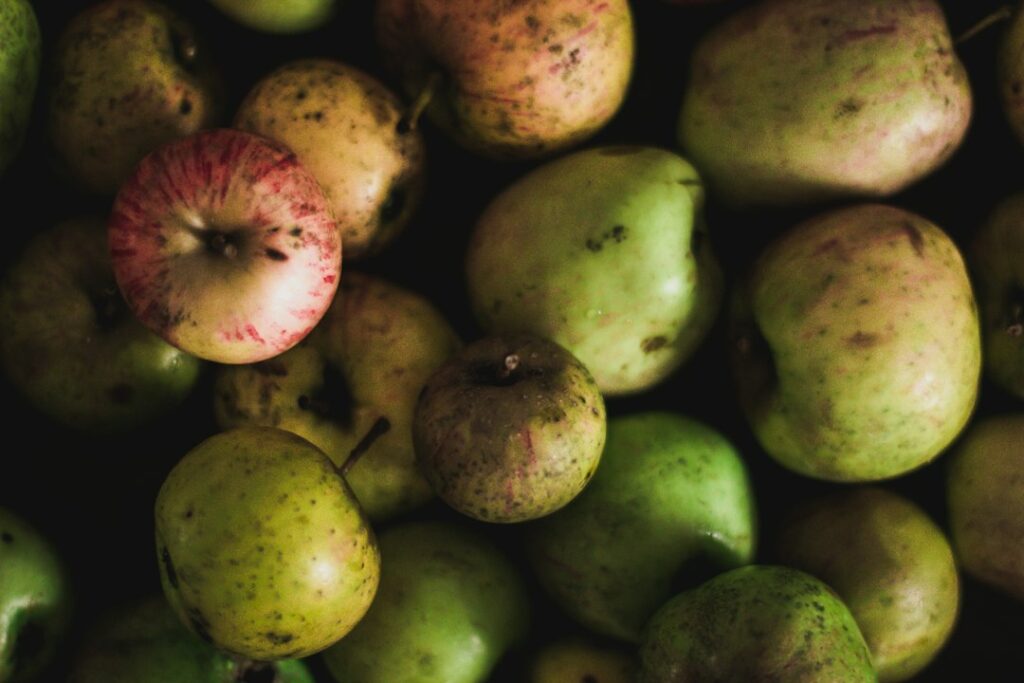
No, apple is high FODMAP in a normal serve. Monash University lists apples as rich in both excess fructose and sorbitol, two FODMAPs that can cause bloating, gas and diarrhoea in IBS. Only a very small piece is low FODMAP. Kiwi, orange, blueberries, pineapple and firm banana are gentler fruit choices.
In this article
When Monash University scientists tested 41 fruits in their lab, only 5 had more fructose than glucose. Apple was one of them. Apples also carry sorbitol, a second FODMAP, so they hit a sensitive gut twice.
So is apple low FODMAP? No, not in a normal serve. Here is why apples upset so many people with IBS, which fruits to pick instead, and how to test if you can bring apples back.
Is apple low FODMAP?
Apple is high FODMAP in a normal serve. Monash University lists apples among the fruits highest in excess fructose and also among the fruits richest in sorbitol.
Apple juice is on the Monash high FODMAP list too. So is dried fruit, which packs the sugars of several apples into a small handful.
Only a very small piece of apple tests as low FODMAP. Serve sizes change after new lab tests, so please check the Monash app for the latest amount for your apple variety.
Why do apples cause bloating and diarrhoea in IBS?
Apples contain two FODMAPs that your small intestine absorbs poorly. Both pull water into the bowel and then feed gas-making bacteria in the colon.
The first is excess fructose. Fructose is absorbed best when it comes with an equal amount of glucose. Apples have more fructose than glucose, so the extra fructose can slip through to the colon.
A 2008 Monash trial tested this in 25 people with IBS. When they were given fructose in drinks with meals, 70% said their symptoms were not well controlled. With glucose, only 14% said so. The more fructose they took, the worse they felt.
The second FODMAP is sorbitol, a sugar alcohol. In a 2014 Monash study, 20 people with IBS and 21 healthy people took 10 g of sorbitol. Gut symptoms rose only in the IBS group, even in people who absorbed it well.
That last point matters. Your gut does not need to fail at absorbing sorbitol to react to it. An IBS gut is simply more sensitive.
Which apple products should you watch out for?
Watch for apple in drinks and snacks, not only in the fruit bowl. These are easy to miss.
- Apple juice and cider. A glass holds the sugars of several apples with none of the chewing to slow you down.
- Dried apple rings and fruit bars. Drying removes water but keeps the FODMAPs.
- Apple sauce and apple puree. These are often used to sweeten baby food, muffins and “no added sugar” snacks.
- Apple juice concentrate. Read labels on jams, cereal bars and sweetened yogurts.
- Sugar-free sweets and gum. These may add sorbitol on top. The NHS advises people with IBS to avoid products sweetened with sorbitol.
If you get bloated often, my guide to the most common bloating causes covers the hidden triggers beyond fruit.
Which fruits can you eat instead of apples?
Plenty of fruits are gentle on IBS. Monash lists cantaloupe, kiwifruit, mandarin, orange, pineapple and blueberries as low FODMAP choices.
Firm banana is another good swap. My guide on whether banana is low FODMAP explains why ripeness changes the answer.
If constipation is your main problem, kiwi is my first pick. A 2021 US trial tested 2 green kiwifruit a day in 79 adults with constipation. Kiwi worked about as well as prunes or psyllium, with the fewest side effects. My IBS constipation guide has the details.
Try this. Keep to one portion of fruit per meal or snack, and space your fruit through the day. The NHS advises people with IBS to eat no more than 3 portions of fresh fruit a day. A portion is 80 g, or about 3 oz.
Are apples good for your gut?
Apples do have gut benefits, but the evidence is weaker than the old saying suggests. I strongly believe gut health plays a major role in nearly every health condition, so I want to be honest about what we know.
Apples are rich in fibre and polyphenols. A 2015 review explained that many apple polyphenols pass the small intestine intact. Gut bacteria in the colon then turn them into active compounds.
Human trials show clear heart benefits. In a 2020 UK trial, 40 adults with mildly high cholesterol ate 2 apples a day for 8 weeks. Their total and LDL cholesterol dropped compared with a sugar-matched apple drink.
The gut bacteria results are less clear. A 2023 UK trial gave 61 adults 2 apples a day for 8 weeks. Their blood insulin after meals improved, but their gut bacteria did not change.
A 2026 Czech pilot study gave 15 healthy adults 3 apples a day for 3 days. Stool chemistry showed no clear overall shift. Both studies were small, and neither included people with IBS.
So apples are a healthy food, but they are not magic for the gut. If they upset you, you can get fibre and polyphenols from gentler fruits, oats and vegetables. My guide to oats and FODMAPs shows one easy way.
How can you test if you tolerate apple?
Test apple after the strict phase of the low FODMAP diet, once your symptoms have settled. Do it on a calm day, when you are not stressed or unwell.
- Day 1. Eat a quarter of a small apple with a meal. Note any symptoms over the next 24 hours.
- Day 2. If all is well, try half a small apple.
- Day 3. If you are still fine, try a whole small apple.
- Stop as soon as symptoms appear. Go back to your usual diet for 2 to 3 days before the next test.
Apple holds both fructose and sorbitol, so it cannot tell you which one you react to. A dietitian can help you test each FODMAP on its own with cleaner test foods.
A strict low FODMAP diet should be short. A 2022 review of 9 trials with 403 people found that it lowers bifidobacteria, a helpful gut bacteria. Bringing foods back keeps your gut fed.
Fear of food is a real risk too. A 2025 study of 811 people found that more food triggers and more food fear went with lower nutrient intake and poorer quality of life. Your goal is the widest diet your gut can handle.
Please see a doctor before you change your diet if you have blood in your stool. The same goes for weight loss without trying, such as 3 kg (about 7 lb).
Frequently asked questions
Are green apples lower in FODMAPs than red apples?
Both green and red apples are high FODMAP in a normal serve. Lab tests show small differences between varieties, but none is low FODMAP at a whole apple. Check the Monash app for the tested serve of each variety.
Is apple juice low FODMAP?
No. Monash lists apple juice as high FODMAP. A glass gives you the sugars of several apples at once. If you want a fruit drink, a small glass of orange juice or water with lemon is a gentler choice.
Does peeling an apple make it low FODMAP?
No. The fructose and sorbitol are in the flesh, not only the skin. Peeling removes some fibre, but the apple stays high FODMAP in a normal serve.
Can I eat apples if I have IBS?
Many people with IBS can eat some apple after testing. Avoid apples during the strict low FODMAP phase. Later, test small portions to find your own limit, and see my IBS diet guide for the full plan.
What I want you to remember
Apple is high FODMAP because it carries both excess fructose and sorbitol. Swap it for kiwi, orange, blueberries or firm banana. Keep fruit to one portion at a time, and test apple later to find your own limit.
If you love creamy foods, read my next guide on whether avocado is low FODMAP. Test what you know in the Trigger or Safe game, and join my free 30-Day Calm Gut Challenge.
Sources
- Monash University FODMAP. Where FODMAPs are found in foods
- Muir JG, et al. Measurement of short-chain carbohydrates in common Australian vegetables and fruits by high-performance liquid chromatography (HPLC). Journal of Agricultural and Food Chemistry, 2009
- Shepherd SJ, et al. Dietary triggers of abdominal symptoms in patients with irritable bowel syndrome. Randomized placebo-controlled evidence. Clinical Gastroenterology and Hepatology, 2008
- Yao CK, et al. Dietary sorbitol and mannitol. Food content and distinct absorption patterns between healthy individuals and patients with irritable bowel syndrome. Journal of Human Nutrition and Dietetics, 2014
- NHS. Irritable bowel syndrome (IBS). Diet, lifestyle and medicines, reviewed 2025
- Chey SW, et al. Exploratory comparative effectiveness trial of green kiwifruit, psyllium or prunes in US patients with chronic constipation. American Journal of Gastroenterology, 2021
- Koutsos A, Tuohy KM, Lovegrove JA. Apples and cardiovascular health. Is the gut microbiota a core consideration? Nutrients, 2015
- Koutsos A, et al. Two apples a day lower serum cholesterol and improve cardiometabolic biomarkers in mildly hypercholesterolemic adults. A randomized, controlled, crossover trial. American Journal of Clinical Nutrition, 2020
- Pushpass RG, et al. Chronic consumption of probiotics, oats, and apples has differential effects on postprandial bile acid profile and cardiometabolic disease risk markers compared with an isocaloric control (cornflakes). A randomized trial. American Journal of Clinical Nutrition, 2023
- Roy Chowdhury C, et al. Impact of short-term Gala apple intake on the human faecal metabolome assessed by 1H NMR spectroscopy. Nutrients, 2026
- So D, et al. Effects of a low FODMAP diet on the colonic microbiome in irritable bowel syndrome. A systematic review with meta-analysis. American Journal of Clinical Nutrition, 2022
- Goyal O, et al. Self-reported food triggers and food fears impact nutrient intake and quality of life in patients with irritable bowel syndrome and functional dyspepsia. Korean Journal of Gastroenterology, 2025
This article shares general information. It is not a diagnosis or a treatment plan. Please talk to your own doctor before you change your diet, medicines or supplements.

Dt. Hashika Vyas
Hashika is a dietitian who works with clients in 15+ countries on gut health, PCOS and weight. She healed her own IBS, and writes every guide on this site to be calm, clear and practical.