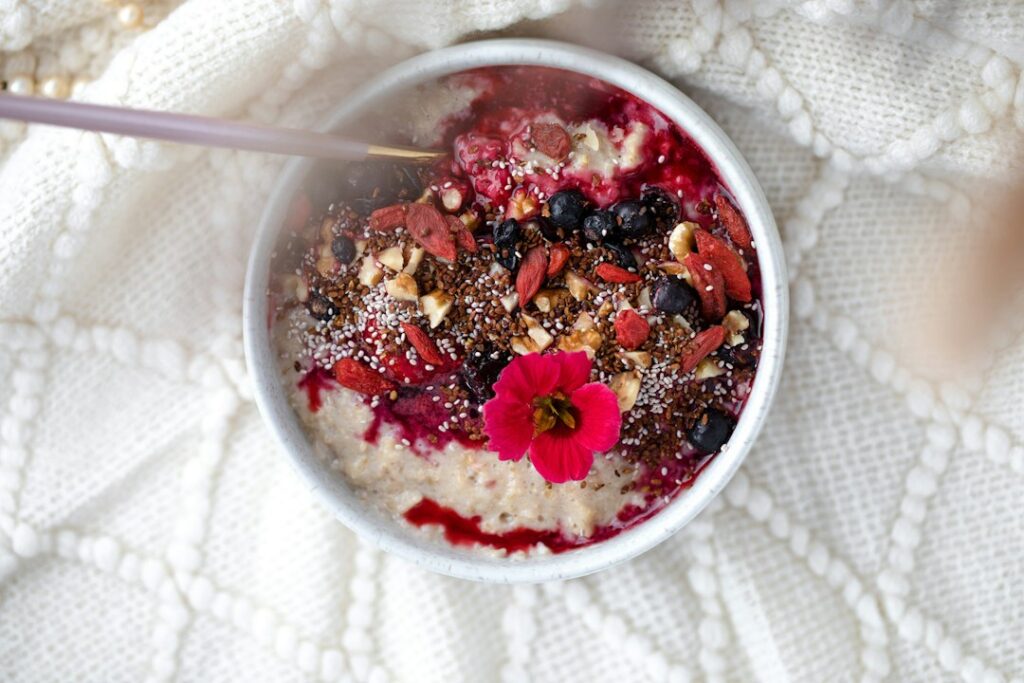
Yes. Oats are low FODMAP in a normal serve, and Monash University found plain oats very low in fructans. Start with about half a cup of dry oats. Watch the extras, like muesli, inulin, oat bars and more than 104 ml of oat milk. Oats also feed friendly gut bacteria.
In this article
In a 2025 Finnish trial, 69 adults ate a low gluten diet built around either oats or rice for 6 weeks. The oat group ended up with more normal stools and more regular bowel movements. The rice group reported more constipation.
So are oats low FODMAP? Yes, in a normal portion. Oats are one of the gentlest grains for IBS, and they feed your gut bacteria too. Here is how much to eat, which oat products to watch and why oats suit a sensitive gut.
Are oats low FODMAP?
Yes, oats are low FODMAP in a normal serve. Monash University, the team that created the low FODMAP diet, tested whole oats, quick oats and oatmeal. All were low FODMAP at a full or half serve.
FODMAPs are short chain carbs that your small intestine absorbs poorly. Gut bacteria ferment them in the colon, which can cause gas, bloating and pain in people with IBS.
In a 2011 Monash lab study of 55 common grain foods, fructans were the most common FODMAP in cereal products. A portion of oats held only 0.11 g of fructans. A portion of wheat-free muesli held 0.96 g, almost nine times more.
Monash keeps the exact gram amounts for each oat type in its app, and it updates them after new tests. Please check the app for the latest serve.
How much oats can I eat with IBS?
Start with a modest bowl, about half a cup of dry oats. Monash lists oats as low FODMAP at a standard serve, and a bigger bowl means more fermentable carbs. That is true of every grain.
FODMAPs also stack up. A small bowl of oats with high FODMAP toppings can add up to a big load in one meal.
Try this. Cook your oats in water or lactose-free milk. Top with firm banana slices, which are low FODMAP. My guide on whether banana is low FODMAP explains how ripeness changes this.
Which oat products are high FODMAP?
The oats are rarely the problem. The extras are. Muesli, oat bars and flavoured instant sachets often add dried fruit, inulin, chicory root or honey.
In the same Monash lab study, a muesli fruit bar held 0.81 g of fructans per portion. That is more than seven times the amount in plain oats.
Oat milk is another one to watch. Monash found oat milk is high FODMAP at 250 ml, about 8.5 fl oz. It is low FODMAP up to 104 ml, about 3.5 fl oz, which is enough for coffee or a splash on cereal.
Try this. Buy plain rolled oats and add your own toppings. Read the label on any oat bar or granola, and skip ones with inulin or chicory root.
Are oats good for your gut?
Yes, oats are one of the best grains for your gut bacteria. I strongly believe gut health plays a major role in nearly every health condition. Oats bring a soluble fibre called beta-glucan that your gut bacteria love.
A 2021 review pulled together 84 studies on oats and gut health, including 23 randomised trials. Eating oats raised friendly Lactobacilli and Bifidobacteria in healthy people and those with coeliac disease. It also raised short-chain fatty acids, the calming fuels gut bacteria make from fibre.
The same review found no studies in IBS at all. So we know oats feed the gut, but not yet how they change IBS symptoms.
In a 2021 Chinese trial, 210 adults with mildly high cholesterol ate 80 g (about 2.8 ounces) of oats or rice daily for 45 days. Oats raised helpful bacteria such as Akkermansia and Roseburia. Several authors worked for an oat company, so read it with care.
This matters because a strict low FODMAP diet can lower friendly bacteria. A 2022 review of 9 trials with 403 people found it consistently cut Bifidobacteria. Oats are one easy way to keep feeding your gut while you calm your symptoms.
Want to grow the variety on your plate? Count your plants in the Gut Garden game.
Do oats help with IBS constipation?
They may, though the evidence is thin. In the Finnish trial, the oat group had more normal stools and bowel movements than the rice group. The rice group had more constipation, likely because they ate less fibre.
A 2024 King’s College London review looked at foods for long-term constipation. It found only one trial on oat bran, so we cannot rank oats against kiwi or prunes yet.
If constipation is your main symptom, my IBS constipation guide covers kiwi, psyllium and what has the best evidence.
Are oats gluten free?
Pure oats do not contain gluten. They contain a related protein called avenin, which most people with coeliac disease tolerate. Regular oats are often mixed with wheat or barley in fields and mills.
A 2017 review in Gastroenterology covered 28 studies, including 8 controlled trials with 661 patients. Pure oats eaten for up to 12 months did not change symptoms or gut damage in coeliac disease. The authors rated the evidence as low quality.
A 2018 Italian trial followed 306 children with coeliac disease. Pure, uncontaminated oats proved a safe choice. The 2025 European coeliac guidelines also include guidance on adding oats safely.
If you have coeliac disease, choose oats labelled gluten free and follow your own doctor’s advice. Gluten is not a FODMAP, but wheat fructans are. That is why many people with IBS feel better on oats than on wheat cereals.
Do oats help your heart too?
Yes. A 2022 review of 13 trials with 927 adults found oat beta-glucan lowered LDL cholesterol by 0.27 mmol/L. That is a small but useful drop.
In the Finnish trial, LDL cholesterol also fell more on oats than on rice. Your gut and heart often benefit from the same simple foods.
For a full plan of what to eat with IBS, read my IBS diet guide. To compare grains, see is rice low FODMAP.
Before you change your diet, please see a doctor about any blood in your stool. The same goes for weight loss without trying, even 3 kg (about 7 lb).
Frequently asked questions
Are overnight oats low FODMAP?
They can be. Use plain oats in a normal portion, and soak them in lactose-free milk or water. Keep oat milk to about 104 ml, and add low FODMAP toppings such as firm banana.
Is oat milk low FODMAP?
Only in small amounts. Monash found oat milk is low FODMAP up to 104 ml, about 3.5 fl oz, and high FODMAP at 250 ml. Use it as a splash in coffee rather than a full glass.
Are quick oats as good as rolled oats for IBS?
Monash tested both and found them low FODMAP at a full or half serve. The safe amounts can differ between oat types, so check the Monash app for your product. Plain is best, without added sugar or fruit.
Why do oats make me bloated?
A large bowl, high FODMAP toppings or a sudden jump in fibre can all cause bloating. Keep the portion modest, add your own low FODMAP toppings and build up slowly. If bloating continues, read my guide to bloating causes.
What I want you to remember
Oats are low FODMAP in a normal portion and one of the gentlest grains for IBS. Watch the extras, like muesli, oat bars, inulin and large glasses of oat milk. Keep plain oats on your plate, because their fibre feeds the gut bacteria that help you heal.
Not sure what to eat or skip? Test yourself with the Trigger or Safe game.
For a calmer gut every day, join my free 30-Day Calm Gut Challenge.
Sources
- Monash University FODMAP. Grain-based foods on a low FODMAP diet, 2016
- Monash University FODMAP. Low FODMAP shopping list, 2025
- Monash University FODMAP. Dairy alternatives (beverage and yoghurt). Low FODMAP options, 2024
- Biesiekierski JR, et al. Quantification of fructans, galacto-oligosaccharides and other short-chain carbohydrates in processed grains and cereals. Journal of Human Nutrition and Dietetics, 2011
- Mannila E, et al. Comparison of low-gluten diets rich in oats or rice. A 6-week randomized clinical trial with metabolically challenged volunteers. Molecular Nutrition and Food Research, 2025
- Valido E, et al. Systematic review of the effects of oat intake on gastrointestinal health. Journal of Nutrition, 2021
- Xu D, et al. The prebiotic effects of oats on blood lipids, gut microbiota, and short-chain fatty acids in mildly hypercholesterolemic subjects compared with rice. A randomized, controlled trial. Frontiers in Immunology, 2021
- So D, et al. Effects of a low FODMAP diet on the colonic microbiome in irritable bowel syndrome. A systematic review with meta-analysis. American Journal of Clinical Nutrition, 2022
- Van der Schoot A, et al. Systematic review and meta-analysis. Foods, drinks and diets and their effect on chronic constipation in adults. Alimentary Pharmacology and Therapeutics, 2024
- Pinto-Sanchez MI, et al. Safety of adding oats to a gluten-free diet for patients with celiac disease. Systematic review and meta-analysis. Gastroenterology, 2017
- Lionetti E, et al. Safety of oats in children with celiac disease. A double-blind, randomized, placebo-controlled trial. Journal of Pediatrics, 2018
- Al-Toma A, et al. European Society for the Study of Coeliac Disease 2025 updated guidelines on the diagnosis and management of coeliac disease in adults. Part 2. United European Gastroenterology Journal, 2026
- Yu J, et al. Effects of oat beta-glucan intake on lipid profiles in hypercholesterolemic adults. A systematic review and meta-analysis of randomized controlled trials. Nutrients, 2022
This article shares general information. It is not a diagnosis or a treatment plan. Please talk to your own doctor before you change your diet, medicines or supplements.

Dt. Hashika Vyas
Hashika is a dietitian who works with clients in 15+ countries on gut health, PCOS and weight. She healed her own IBS, and writes every guide on this site to be calm, clear and practical.