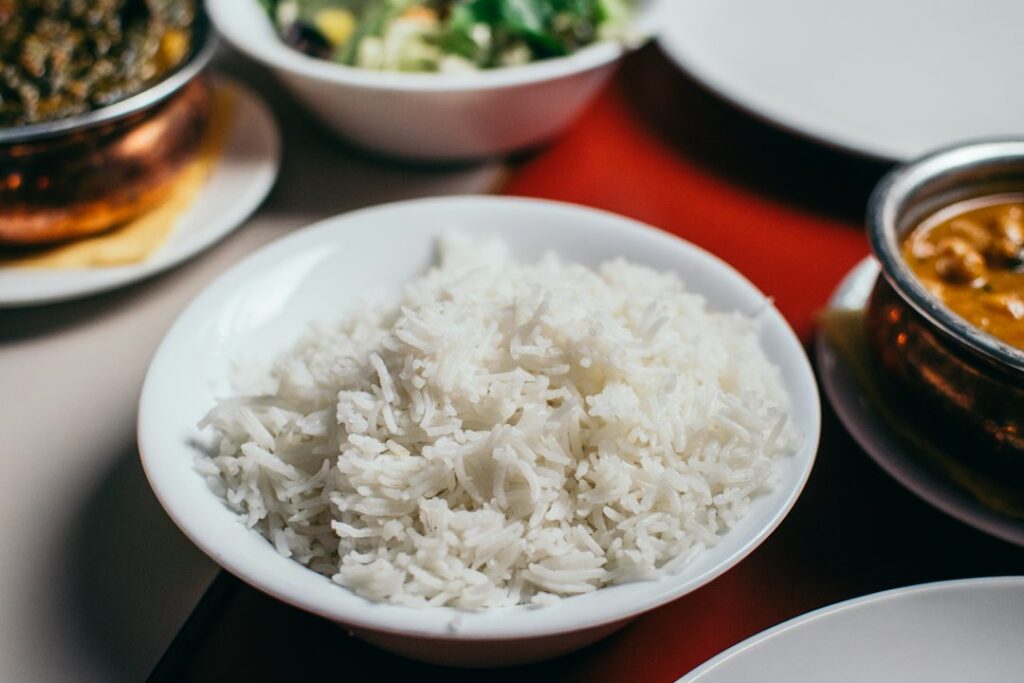
Yes. Rice is low FODMAP, and Monash University lab tests found no fructans in it. White, brown and basmati rice all suit a low FODMAP diet. Choose white rice during a diarrhoea flare and brown rice for more fibre. Cool leftovers within 1 hour and eat them within a day.
In this article
Rice is the grain people turn to when their gut is upset. There is good reason for that. When Monash University measured fructans in 55 common grain foods, rice came out at zero.
So is rice low FODMAP? Yes. White, brown and basmati rice are all low FODMAP, which makes rice one of the safest staples for IBS. But the best rice for you depends on your symptoms. Here is how to choose, cook and store it.
Is rice low FODMAP?
Yes, rice is low FODMAP. In a 2011 Monash lab study, fructans per portion ranged from 1.12 g in couscous down to 0 g in rice. Monash lists brown rice among the whole grains it tested and found low FODMAP, and plain rice is on its low FODMAP shopping list.
Fructans are chains of sugar that your small intestine cannot digest. They are the most common FODMAP in grains, and they ferment in the colon to make gas. Rice simply does not carry them.
A 2024 Polish lab study tested fructans in cooked grains. It named white long grain rice and arborio rice as likely safe, and advised caution with barley and couscous.
Serving sizes can change after new tests. Please check the Monash app for the latest amounts.
Which rice is best for IBS?
The best rice depends on your main symptom. All plain rice is low FODMAP, so the real difference is fibre.
- If you have diarrhoea, white or basmati rice is a gentle, low fibre choice during a flare.
- If you have constipation, brown rice gives you more fibre. White rice alone may not be enough.
- If you have mixed symptoms, try a mix of white and brown rice and see what your gut prefers.
A 2025 Finnish trial shows why fibre matters. For 6 weeks, 69 adults ate a low gluten diet built around rice or oats. The rice group had more constipation symptoms, likely because they ate less fibre. The oat group had more normal stools.
My IBS diarrhoea diet and IBS constipation guide show how to build meals around each type.
Is brown rice healthier than white rice?
For long-term health, brown rice has the edge. A 2022 review in BMJ Open pooled cohort studies with more than 577,000 people. Eating the most white rice was linked to a 16% higher risk of type 2 diabetes.
Brown rice went the other way. Each daily 50 g serve, about 1.8 ounces, was linked to a 13% lower risk. These are observational studies, so they show links rather than proof.
You do not need to drop white rice. Mixing in brown rice, or other low FODMAP grains like quinoa and oats, gives your gut more fibre to work with.
Does cooling rice make it better for your gut?
Cooling cooked rice raises its resistant starch, a type of starch that feeds gut bacteria. In a 2015 Indonesian study, fresh white rice held 0.64 g of resistant starch per 100 g. Rice chilled for 24 hours at 4°C (39°F) and reheated held 1.65 g.
In 15 healthy adults, the chilled and reheated rice also caused a smaller rise in blood sugar. It was a small study, but the idea is simple and cheap to try.
Food safety matters here. Rice can carry spores of a bacteria called Bacillus cereus that survive cooking. The UK Food Standards Agency advises these steps.
- Cool leftover rice quickly, ideally within 1 hour.
- Keep it in the fridge for no more than 1 day.
- Reheat it only once, until it is steaming hot all the way through.
Try this. Cook a batch of rice, spread it on a tray to cool, then chill it. Use it the next day in a stir fry or rice salad.
Is rice good for your gut?
Rice is gentle on the gut, and the evidence for rice-based eating is encouraging. I strongly believe gut health plays a major role in nearly every health condition, and staple foods matter most because we eat them daily.
A 2026 Rome Foundation analysis looked at more than 54,000 people in 26 countries. The eating pattern found mostly in Asian countries came with the lowest IBS rate, 2.6%. A second analysis linked rice-heavy diets to fewer bowel disorders. Survey links cannot prove rice is the reason.
Resistant starch from cooled rice reaches your colon, where bacteria ferment it into helpful short-chain fatty acids. My guide on whether banana is low FODMAP explains how green banana starch works in the same way.
Researchers have also tested rice bran. In a 2014 Japanese pilot trial of 40 people with IBS, a rice bran supplement helped 63% compared with 30% on placebo. It was small and short, so it needs bigger trials.
Rice still has less fibre than many grains. A strict low FODMAP diet can lower friendly gut bacteria, so mix rice with other plant foods. Track your variety in the Gut Garden game.
Is arsenic in rice a worry?
It is worth knowing about, especially if rice is your main grain. Rice naturally takes up arsenic from the soil and water it grows in.
A 2025 US study followed 35 children with coeliac disease who swapped wheat for a gluten free diet. After 6 months, their urine arsenic levels rose from 3.3 to 13.6 µg/L. The levels were far below toxic, and the long-term effect is unknown.
A simple cooking method helps. A 2021 University of Sheffield study first parboiled the rice in boiling water and poured that water away. Then they cooked it in fresh water until it was absorbed. This removed 54% of inorganic arsenic from brown rice and 73% from white rice.
Try this. Rotate rice with oats, quinoa and potatoes during the strict low FODMAP phase, rather than eating rice at every meal. See are oats low FODMAP for a high fibre grain that suits most guts.
Before you change your diet, please see a doctor about any blood in your stool. The same goes for weight loss without trying, even 3 kg (about 7 lb).
Frequently asked questions
Is basmati rice low FODMAP?
Yes. Basmati is a long grain white rice, and plain white rice is low FODMAP. It is a good choice for curries, pilafs and rice bowls. Keep sauces low FODMAP too, since onion and garlic are common hidden triggers.
Are rice cakes low FODMAP?
Plain rice cakes are made from rice, so they are usually a gentle snack. Flavoured ones can contain onion, garlic or honey. Check the label and the Monash app for your brand.
Is rice good for IBS diarrhoea?
Plain white rice is a gentle, low fibre food that many people with IBS diarrhoea tolerate well. It works best in a balanced meal with protein and low FODMAP vegetables. If diarrhoea lasts more than a few days, see your doctor.
Can rice cause bloating?
Plain rice rarely causes bloating, because it has no fructans. Large portions, rich sauces, onion, garlic or eating fast can still upset your gut. If you bloat after rice meals, look at what you eat with it.
What I want you to remember
Rice is low FODMAP and one of the safest grains for IBS. Choose white rice during a diarrhoea flare and add brown rice when you need more fibre. Cool it safely to boost resistant starch, and rotate it with other grains to feed a varied gut.
For the full picture of what to eat with IBS, read my IBS diet guide. Test your food knowledge with the Trigger or Safe game.
For a calmer gut every day, join my free 30-Day Calm Gut Challenge.
Sources
- Biesiekierski JR, et al. Quantification of fructans, galacto-oligosaccharides and other short-chain carbohydrates in processed grains and cereals. Journal of Human Nutrition and Dietetics, 2011
- Monash University FODMAP. Grain-based foods on a low FODMAP diet, 2016
- Monash University FODMAP. Low FODMAP shopping list, 2025
- Pejcz E, et al. Fructan concentrations in cooked cereal grains as a nutritional consideration for low-FODMAP diet. Molecules, 2024
- Mannila E, et al. Comparison of low-gluten diets rich in oats or rice. A 6-week randomized clinical trial with metabolically challenged volunteers. Molecular Nutrition and Food Research, 2025
- Yu J, et al. White rice, brown rice and the risk of type 2 diabetes. A systematic review and meta-analysis. BMJ Open, 2022
- Sonia S, et al. Effect of cooling of cooked white rice on resistant starch content and glycemic response. Asia Pacific Journal of Clinical Nutrition, 2015
- Food Standards Agency. Home food fact checker, updated 2026
- Jaafari H, et al. Dietary patterns are associated with variations in the global prevalence and severity of Rome IV irritable bowel syndrome. Clinical Gastroenterology and Hepatology, 2026
- Bushyhead D, et al. The association between usual diet and bowel disorders of gut-brain interaction. Analyses from the Rome Foundation Global Epidemiology Study. Journal of Neurogastroenterology and Motility, 2026
- Kamiya T, et al. Therapeutic effects of Biobran, modified arabinoxylan rice bran, in improving symptoms of diarrhea predominant or mixed type irritable bowel syndrome. A pilot, randomized controlled study. Evidence-Based Complementary and Alternative Medicine, 2014
- So D, et al. Effects of a low FODMAP diet on the colonic microbiome in irritable bowel syndrome. A systematic review with meta-analysis. American Journal of Clinical Nutrition, 2022
- Du N, et al. Effect of adopting a gluten-free diet on exposure to arsenic and other heavy metals in children with celiac disease. A prospective cohort study. American Journal of Gastroenterology, 2025
- Menon M, et al. Improved rice cooking approach to maximise arsenic removal while preserving nutrient elements. Science of the Total Environment, 2021
This article shares general information. It is not a diagnosis or a treatment plan. Please talk to your own doctor before you change your diet, medicines or supplements.

Dt. Hashika Vyas
Hashika is a dietitian who works with clients in 15+ countries on gut health, PCOS and weight. She healed her own IBS, and writes every guide on this site to be calm, clear and practical.