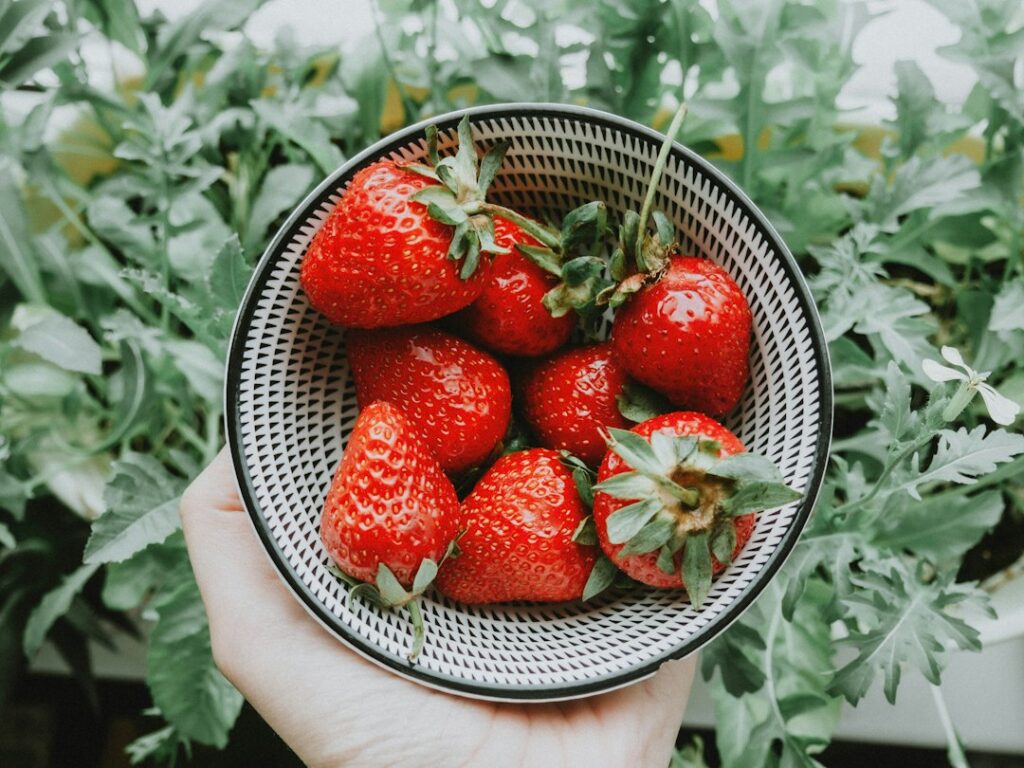
Yes, strawberries are low FODMAP in a normal portion. Monash data shows 65 g, about 5 medium strawberries or 2.3 oz, is low FODMAP. At 75 g they hold a moderate amount of fructose, and at 100 g or more a large amount. Keep to 65 g per sitting during the elimination phase.
In this article
- Are strawberries low FODMAP?
- Why do large servings of strawberries cause IBS symptoms?
- Are strawberries good for your gut bacteria?
- Are strawberries healthy?
- Which other berries and fruits are low FODMAP?
- How can you eat strawberries on a low FODMAP diet?
- Frequently asked questions
- What I want you to remember
Are strawberries low FODMAP? Yes, in the right portion. A serve of 65 g, about 5 medium strawberries, is low FODMAP. Larger bowls bring more fructose, and that is where many people with IBS run into trouble.
In this guide I share the exact serves and why fructose matters. I also explain what strawberries do for your gut bacteria and how to enjoy them without a flare.
Are strawberries low FODMAP?
Strawberries are low FODMAP at 65 g, which is about 5 medium berries or 2.3 oz. Monash University, the team that created the low FODMAP diet, tests foods in its lab and keeps the serve sizes in its app.
Karlijn’s Kitchen, a low FODMAP site, reports the Monash app figures in its April 2024 strawberry guide.
- 65 g (about 5 medium berries, 2.3 oz). Low FODMAP. This is the serve to use in the elimination phase.
- 75 g (about 6 medium berries, 2.6 oz). A moderate amount of fructose.
- 100 g or more (about 8 medium berries, 3.5 oz). A large amount of fructose.
The same source says Monash changed the strawberry serve to 65 g in 2021. Food serves do change as testing improves, so check the Monash app for the latest figure.
For size, USDA data puts a medium strawberry at about 12 g. A whole cup weighs about 144 g, so a low FODMAP serve is a little under half a cup.
Why do large servings of strawberries cause IBS symptoms?
Large servings of strawberries cause symptoms because of fructose, the F in FODMAP. Strawberries hold slightly more fructose than glucose. By USDA figures, 100 g of raw strawberries has 2.44 g of fructose and 1.99 g of glucose.
Glucose helps your small intestine absorb fructose. When fructose is higher than glucose, some of it can travel on to the colon. There gut bacteria ferment it and it pulls in water. In a sensitive gut, that can mean bloating, gas, pain and loose stools.
Fructose is not the most common IBS trigger. In a 2024 trial in Gastroenterology, 117 people with IBS tested each FODMAP hidden in a powder. Fructose brought back symptoms in 27% of them. Fructans did so in 56% and mannitol in 54%.
So strawberries may be fine for you even in bigger portions. The only way to know is to test them during the reintroduction phase.
Is fructose intolerance about absorption or your gut?
Research suggests your gut’s sensitivity may matter more than absorption. In a 2021 trial, 30 people with gut disorders drank 35 g of fructose or water. People who got symptoms absorbed the fructose just as well as people who did not.
What differed was gas. Symptoms rose with the hydrogen and methane in their breath, gases that gut bacteria make. The authors suggest gut bacteria or gut sensitivity explain fructose intolerance better than poor absorption.
A 2023 pilot study also gives some hope. It gave fructose to 39 people with IBS who had improved on a low FODMAP diet. Most of those who responded to the diet handled a 15 g dose of sugar. The authors suggest testing higher doses during reintroduction.
Are strawberries good for your gut bacteria?
Strawberries may help your gut bacteria, though human studies are still small. I strongly believe gut health shapes nearly every part of our health, and colourful fruits like strawberries feed it in a few ways.
Strawberries are rich in polyphenols, plant compounds that reach the colon largely intact. There your bacteria turn ellagitannins into compounds called urolithins.
- A 2025 German trial. 69 healthy older adults ate different amounts of fresh and freeze dried strawberries for 10 weeks. The group eating the most had a shift in gut bacteria and more Faecalibacterium, a helpful bacterium that makes butyrate.
- A 2018 trial. 19 healthy older adults took freeze dried strawberry powder equal to 2 cups of fresh berries daily for 90 days. Urolithins and other strawberry compounds stayed in their blood, a sign of gut bacteria at work.
- A 2013 Finnish trial. Adults with signs of metabolic syndrome ate a mix of strawberries, raspberries and cloudberries. How well they used the berry ellagitannins depended on their gut bacteria.
These studies used healthy people or mixed berries, not people with IBS. Many used doses far above the low FODMAP serve. So treat them as early clues, not proof that strawberries ease IBS.
Are strawberries healthy?
Yes, strawberries are a light, nutrient rich fruit. By USDA figures, 100 g (3.5 oz) of raw strawberries gives the following.
- About 32 kcal
- 2 g of fibre
- 58.8 mg of vitamin C
- 153 mg of potassium and 24 micrograms of folate
- 0.39 mg of manganese
Even a 65 g low FODMAP serve gives you about 38 mg of vitamin C, with only about 21 kcal.
Strawberries may help blood sugar too. In a 2025 trial in the Journal of Nutrition, adults with prediabetes ate 2.5 servings of strawberries a day for 12 weeks. Their insulin, fasting glucose, HbA1c and cholesterol improved compared with a control period. The trial was small and used far more than a low FODMAP serve, so it needs repeating.
Which other berries and fruits are low FODMAP?
Several fruits are safe in normal portions. Karlijn’s Kitchen lists these Monash serves in its fruit guide, last updated January 2023.
- Blueberries. Low up to 500 g, the most generous berry. My blueberry guide has the details.
- Raspberries. Low up to 58 g, about 2 oz.
- Green kiwifruit. Low up to 240 g, about 3 kiwis.
- Oranges. Low up to 130 g, about 1 medium orange.
- Blackberries. On the avoid list, with no low FODMAP serve.
Monash also lists cantaloupe, mandarin and pineapple as low FODMAP fruits. My guides to grapes, bananas and apples cover three more fruits people ask about.
How can you eat strawberries on a low FODMAP diet?
Keep each portion to 65 g and space your fruit through the day. Here are easy ways to do it.
- Weigh once, then eyeball. Weigh 65 g one time so you know what 5 medium berries look like.
- Space your fruit. Spread fruit across your meals and snacks so fructose does not stack up at one sitting.
- Top your breakfast. Slice strawberries over oats, lactose free yogurt or a chia pudding. My low FODMAP breakfast guide has more ideas.
- Mix your berries. Combine 65 g of strawberries with a handful of blueberries for a bigger bowl.
- Use frozen berries. Frozen strawberries are the same fruit, so I use the same 65 g weight. Weigh them before they thaw.
- Be careful with smoothies. It is easy to blend 2 or 3 cups of fruit into one glass. Stick to one fruit serve per smoothie.
- Read jam and snack labels. Some strawberry products add apple juice, inulin, honey or high fructose corn syrup.
- Test bigger portions later. After the elimination phase, try 100 g and watch your gut for 2 to 3 days. My guide to the 3 phases of the low FODMAP diet shows how.
I could not find public Monash figures for freeze dried or dried strawberries. Drying concentrates the sugars, so a small handful may hold as much fructose as a big bowl of fresh berries. Treat them as untested.
Strawberries can also cause allergy symptoms in some people, such as an itchy mouth, hives or swelling. That is not a FODMAP reaction. See a doctor if it happens.
Want to practise spotting safe foods? Play my Trigger or Safe game.
Frequently asked questions
How many strawberries can I eat with IBS?
A low FODMAP serve of strawberries is 65 g, about 5 medium berries, according to Monash data reported by Karlijn’s Kitchen. At 75 g they hold a moderate amount of fructose, and at 100 g or more a large amount. After the elimination phase you can test bigger portions to find your own limit.
Are strawberries high in fructose?
Strawberries are not very high in fructose, but they hold slightly more fructose than glucose. By USDA figures, 100 g has 2.44 g of fructose and 1.99 g of glucose. That small excess only matters in larger portions, which is why the low FODMAP serve is 65 g.
Are frozen strawberries low FODMAP?
Frozen strawberries are simply fresh strawberries that have been frozen, so I use the same 65 g serve. Weigh them while frozen and check the bag has no added sugar, juice or syrup. Monash may not list frozen strawberries separately, so check the app for updates.
Is strawberry jam low FODMAP?
I could not find a public Monash figure for strawberry jam. A thin spread of jam made only with strawberries and sugar is usually a small amount of fruit. Avoid jams sweetened with apple or pear juice concentrate, honey or high fructose corn syrup, and keep to 1 tablespoon.
Can strawberries cause bloating?
Yes, large portions can cause bloating in people sensitive to fructose. Fructose that is not absorbed is fermented by gut bacteria and pulls water into the gut. Keeping to 65 g per sitting and spacing fruit through the day helps most people avoid it.
What I want you to remember
Strawberries are low FODMAP at 65 g, about 5 medium berries. Bigger bowls add fructose, which can upset a sensitive gut. Keep portions sensible, space your fruit and test your own limit after the elimination phase.
Strawberries bring vitamin C, fibre and polyphenols that may feed your gut bacteria. For a wider plan, read my complete IBS diet guide, and join my free 30-Day Calm Gut Challenge for a calm, guided reset.
Sources
- Karlijn's Kitchen. Are strawberries low FODMAP? Updated April 2024
- Karlijn's Kitchen. Low FODMAP fruits. Updated January 2023
- Monash University. High and low FODMAP foods
- USDA FoodData Central. Strawberries, raw (SR Legacy 167762)
- Van den Houte K, et al. Efficacy and findings of a blinded randomized reintroduction phase for the low FODMAP diet in irritable bowel syndrome. Gastroenterology, 2024
- Wilder-Smith C, et al. Fructose intolerance is not associated with malabsorption in patients with functional gastrointestinal disorders. Neurogastroenterology and Motility, 2021
- Cuff C, et al. Randomized controlled pilot study assessing fructose tolerance during fructose reintroduction in non-constipated irritable bowel syndrome patients. Neurogastroenterology and Motility, 2023
- Meiners F, et al. Strawberry dietary intervention influences diversity and increases abundances of SCFA-producing bacteria in healthy elderly people. Microbiology Spectrum, 2025
- Sandhu AK, et al. Metabolic fate of strawberry polyphenols after chronic intake in healthy older adults. Food and Function, 2018
- Puupponen-Pimia R, et al. Effects of ellagitannin-rich berries on blood lipids, gut microbiota and urolithin production in human subjects with symptoms of metabolic syndrome. Molecular Nutrition and Food Research, 2013
- Basu A, et al. Strawberries improve insulin resistance and related cardiometabolic markers in adults with prediabetes. A randomized controlled crossover trial. Journal of Nutrition, 2025
This article shares general information. It is not a diagnosis or a treatment plan. Please talk to your own doctor before you change your diet, medicines or supplements.

Dt. Hashika Vyas
Hashika is a dietitian who works with clients in 15+ countries on gut health, PCOS and weight. She healed her own IBS, and writes every guide on this site to be calm, clear and practical.