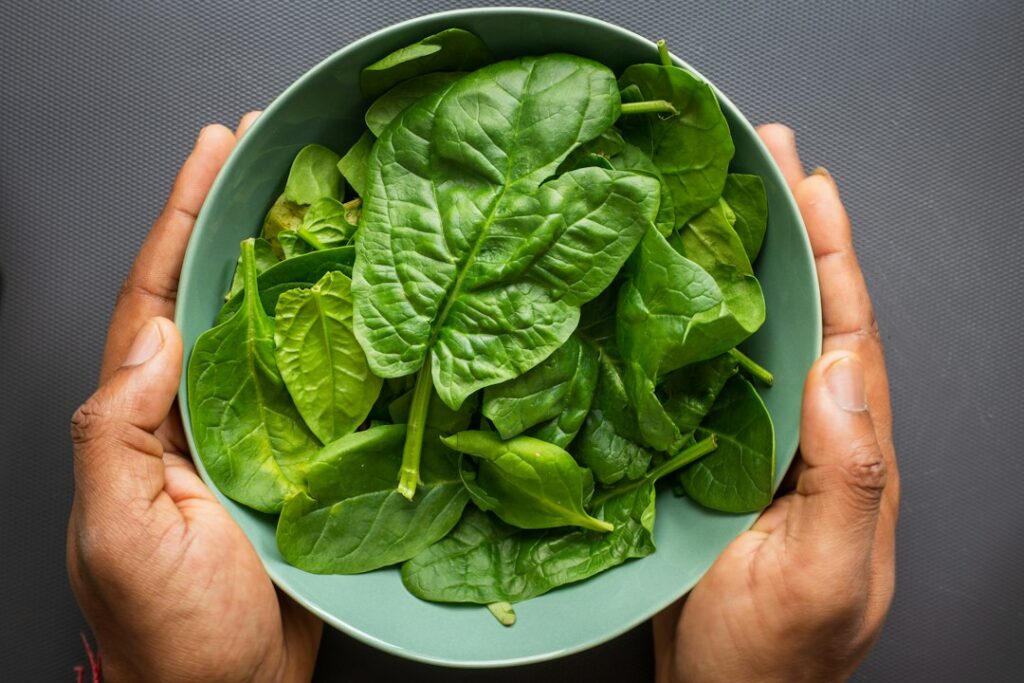
Yes, spinach is low FODMAP. Monash University lists spinach as low at a 75 g (2.65 oz) serve. Regular English spinach has no upper limit reported, while baby spinach has moderate fructans at 150 g or more. Cooked spinach is low FODMAP too, so weigh it raw before cooking.
In this article
- Is spinach low FODMAP?
- Why does baby spinach have a limit?
- Is cooked spinach low FODMAP?
- Is raw or cooked spinach better for you?
- How does spinach help your gut bacteria?
- Does spinach help your brain and weight?
- How can you add spinach to a low FODMAP diet?
- Who should be careful with spinach?
- Frequently asked questions
- What I want you to remember
Spinach holds a sugar that your body cannot use at all. Only certain gut bacteria can eat it. That makes this leafy green a quiet gift to your gut, and good news if you live with IBS.
So, is spinach low FODMAP? Yes. Regular spinach and baby spinach are both low FODMAP at a normal serve, raw or cooked. In this guide I explain the safe portions, the raw vs cooked question and why spinach is worth keeping on your plate.
Is spinach low FODMAP?
Yes, spinach is low FODMAP. Monash University created the low FODMAP diet. It lists spinach among leafy vegetables that are low at 1 standard serve of 75 g (2.65 oz).
Monash tests the FODMAP content of foods in its lab. Its app holds the full results. Karlijn’s Kitchen, a low FODMAP site that reports the app figures, lists three types of spinach in its 2024 update.
- English spinach, raw. Low FODMAP at 75 g, with no maximum serve listed.
- Baby spinach, raw. Low FODMAP at 75 g. At 150 g (5.3 oz) or more, it has a moderate amount of fructans.
- Water spinach, raw. Low FODMAP at 75 g and still low up to 500 g (about 1.1 lb).
Monash updates its app as it tests foods again. Please check your Monash app for the latest serve before you change your portions.
Why does baby spinach have a limit?
Baby spinach has a limit because large serves contain fructans. Fructans are chains of fructose sugar that many people with IBS react to.
Monash says the main FODMAPs in vegetables are fructans and mannitol. A 2024 Belgian trial tested each FODMAP one by one in 117 people with IBS. Fructans were the most common trigger, bringing symptoms back in 56% of people.
So a side salad of baby spinach is fine for most people. A huge bowl of 150 g or more may cause trouble if fructans are one of your triggers. My guide to the 3 phases of the low FODMAP diet explains how to test your own triggers.
Is cooked spinach low FODMAP?
Yes, cooked spinach is low FODMAP too. Karlijn’s Kitchen explains that the Monash app usually gives serves for raw vegetables. Weigh your spinach raw, then cook it.
This matters because spinach shrinks a lot when cooked. A big pan of fresh leaves turns into a small spoonful. If you weigh it after cooking, you may eat far more than you think.
Try this. Weigh out 75 g (2.65 oz) of raw spinach once, then cook it. Look at how much is left. That picture helps you judge a cooked serve by eye from then on.
Is raw or cooked spinach better for you?
Both are good for you. Cooking changes a few nutrients, and it lowers oxalate, which matters if you get kidney stones.
Here is what USDA data shows for 100 g (3.5 oz) of spinach.
- Raw spinach. 23 kcal, 2.2 g fibre, 2.7 mg iron, 99 mg calcium, 194 µg folate and 28 mg vitamin C.
- Boiled and drained spinach. 23 kcal, 2.4 g fibre, 3.6 mg iron, 136 mg calcium, 146 µg folate and 10 mg vitamin C.
Cooked spinach packs more iron and calcium into each 100 g because it has lost water. Raw spinach keeps more vitamin C and folate. Both are very rich in vitamin K, with about 480 to 490 µg per 100 g.
What about oxalate and kidney stones?
Spinach is high in oxalate, a natural compound that can form kidney stones in some people. NIDDK lists spinach among foods to limit if you have had calcium oxalate stones.
Boiling helps. A 2005 study of 9 vegetables found boiling cut soluble oxalate by 30 to 87%. Steaming cut it by 5 to 53%. Almost all of the lost oxalate ended up in the cooking water, so pour that water away.
If you have had kidney stones, ask your doctor which stone type you had before you eat a lot of spinach. A dietitian can help you plan meals around it.
How does spinach help your gut bacteria?
I strongly believe gut health shapes nearly every part of our health. Spinach is a good example, because it feeds gut bacteria with a sugar only they can use.
Green vegetables contain sulfoquinovose, a sulfur-containing sugar. A 2021 study in The ISME Journal showed that a few common gut bacteria break it down. One of them, Eubacterium rectale, is a well-known gut bacterium.
A 2025 study in Microbiome found that neither mice nor human gut cells could break down this sugar themselves. Only the gut bacteria could. The authors said this gives it potential as a prebiotic, a food for helpful bacteria.
There are honest limits here. These are lab, stool sample and mouse studies, not trials in people with IBS. Breaking down this sugar also makes hydrogen sulfide, a gas with mixed effects on health. We do not yet know the best amount.
For a wider view of plant variety and your gut, read my guide to 30 plants a week. Spinach counts as one plant.
Does spinach help your brain and weight?
Leafy greens are linked to slower brain ageing, but the evidence is observational. A 2018 study followed 960 older adults for an average of 4.7 years.
People who ate the most leafy greens, about 1.3 servings a day, had slower memory and thinking decline. The difference was like being 11 years younger. This shows a link, not proof that spinach caused it.
You may also see spinach extract sold for weight loss. These supplements contain thylakoids, tiny parts of the green leaf. A 2025 review of 5 trials found they reduced hunger a little in the short term. That is a supplement, not a spinach salad, and more research is needed.
How can you add spinach to a low FODMAP diet?
Stick to about 75 g (2.65 oz) of raw baby spinach per meal, and enjoy regular spinach freely. Here are easy ways to use it.
- Breakfast. Stir a handful into scrambled eggs or an omelette.
- Smoothies. Blend spinach with firm banana, lactose-free yogurt and a few strawberries.
- Lunch. Use baby spinach as a salad base with rice, chicken or firm tofu and an olive oil dressing.
- Dinner. Wilt spinach into pasta, risotto or a potato bake at the end of cooking.
- Flavour. Use garlic-infused oil instead of garlic, which is high in fructans.
Creamed spinach is often made with milk, cream, onion and garlic, which can all be high FODMAP. Try lactose-free cream, hard cheese and garlic-infused oil instead. My guide on which cheeses are low FODMAP can help.
Want to test what you know? Play my Trigger or Safe game to sort common foods into gut-friendly and risky.
Who should be careful with spinach?
Most people can eat spinach freely. A few groups should check with their doctor first.
- People who have had kidney stones. Spinach is high in oxalate. Boil it and ask your doctor about portions.
- People taking warfarin. Spinach is very high in vitamin K, which affects how warfarin works. Keep your intake steady and ask your doctor before big changes.
- People with fructan triggers. Keep baby spinach under 150 g at one meal.
For a full plan around IBS, read my complete IBS diet guide. If you like other greens, my guide to whether broccoli is low FODMAP covers heads vs stalks.
Frequently asked questions
How much spinach can I eat on a low FODMAP diet?
Monash lists spinach as low FODMAP at 75 g (2.65 oz). Karlijn’s Kitchen reports no upper limit for English spinach in the Monash app. Baby spinach has a moderate amount of fructans at 150 g (5.3 oz) or more.
Is frozen spinach low FODMAP?
Frozen spinach is plain spinach that has been blanched and frozen, so it should behave like cooked spinach. Monash has not published a separate public figure for it. Check the label for added onion or garlic, and check your Monash app.
Is spinach good for IBS with constipation?
Spinach adds some fibre, about 2.2 g per 100 g raw. That helps a little, but it is not a large dose. Pair it with other low FODMAP fibre sources like oats, kiwi fruit and chia seeds. Drink enough water too.
Can spinach cause gas or bloating?
For most people, a normal serve of spinach is gentle. Very large serves of baby spinach contain fructans, which can cause gas and bloating in sensitive people.
Does spinach turn your poop green?
It can. Spinach is full of chlorophyll, the green plant pigment, and a large serving can tint your poop green. This is harmless. My guide to green poop explains other causes and when to see a doctor.
What I want you to remember
Spinach is low FODMAP. Regular spinach is safe in generous amounts, and baby spinach is fine up to about 75 g per meal. Weigh it raw, then cook it however you like.
Spinach also feeds gut bacteria with a sugar only they can use. Boil it if you get kidney stones, and keep it steady if you take warfarin. For a calm, guided gut reset, join my free 30-Day Calm Gut Challenge.
Sources
- Monash University. Low FODMAP shopping list, 2025
- Monash University. High and low FODMAP foods
- Karlijn's Kitchen. Is spinach low FODMAP? Updated 2024
- Van den Houte K, et al. Efficacy and findings of a blinded randomized reintroduction phase for the low FODMAP diet in irritable bowel syndrome. Gastroenterology, 2024
- USDA FoodData Central. Spinach, raw (SR Legacy 168462)
- USDA FoodData Central. Spinach, cooked, boiled, drained, without salt (SR Legacy 168463)
- Chai W, Liebman M. Effect of different cooking methods on vegetable oxalate content. Journal of Agricultural and Food Chemistry, 2005
- NIDDK. Eating, diet and nutrition for kidney stones
- Hanson BT, et al. Sulfoquinovose is a select nutrient of prominent bacteria and a source of hydrogen sulfide in the human gut. The ISME Journal, 2021
- Krasenbrink J, et al. Sulfoquinovose is exclusively metabolized by the gut microbiota and degraded differently in mice and humans. Microbiome, 2025
- Morris MC, et al. Nutrients and bioactives in green leafy vegetables and cognitive decline. Prospective study. Neurology, 2018
- Nikrad N, et al. Thylakoid supplementation and hunger and fullness perception. A systematic review and dose-response meta-analysis of randomized controlled trials. Nutrition Reviews, 2025
This article shares general information. It is not a diagnosis or a treatment plan. Please talk to your own doctor before you change your diet, medicines or supplements.

Dt. Hashika Vyas
Hashika is a dietitian who works with clients in 15+ countries on gut health, PCOS and weight. She healed her own IBS, and writes every guide on this site to be calm, clear and practical.