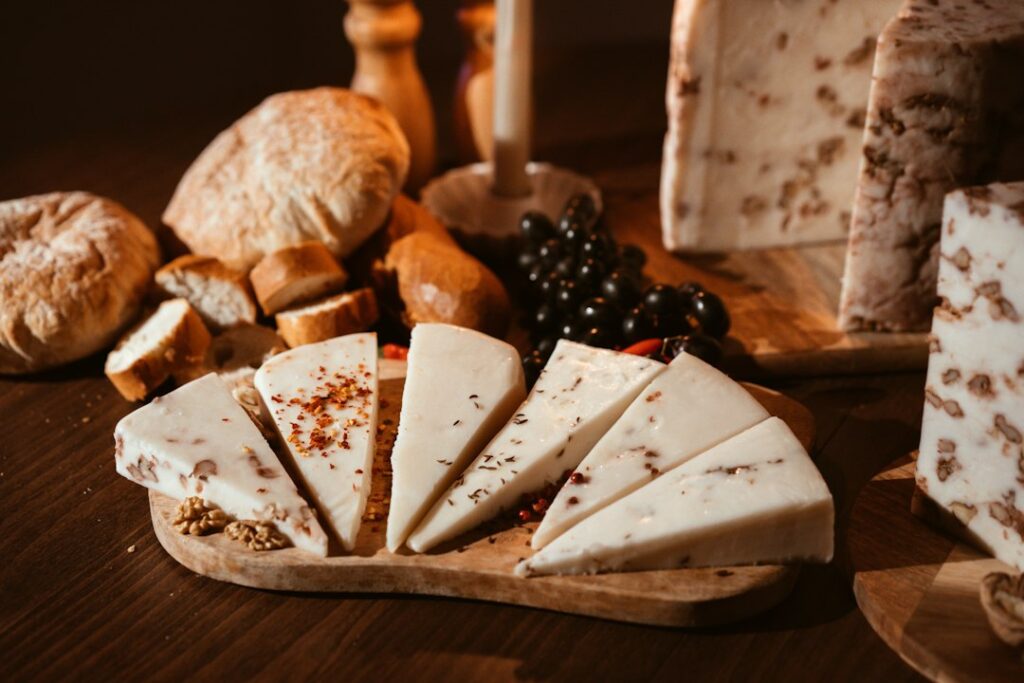
Yes, most cheese is low FODMAP. Monash University lists hard cheeses such as cheddar and parmesan, plus brie, camembert and feta, as low FODMAP. Most lactose drains away with the whey when cheese is made. Fresh soft cheeses like ricotta, cottage cheese and cream cheese hold more lactose, so keep them small or choose lactose-free.
In this article
- Is cheese low FODMAP?
- Why is most cheese low in lactose?
- Which cheeses are best for IBS?
- Which cheeses are high FODMAP?
- How much lactose can you handle?
- Is lactose a common IBS trigger?
- Is cheese good for your gut?
- How can you enjoy cheese on a low FODMAP diet?
- Frequently asked questions
- What I want you to remember
A slice of sharp cheddar holds almost no lactose. According to USDA data, 100 g (3.5 oz) of it has just 0.18 g. Yet many people with IBS drop all dairy the moment they hear the word FODMAP.
So is cheese low FODMAP? Many types are, and you may not need to give up your favourites at all. In this guide I explain which cheeses are safest, which to keep small and what cheese may do for your gut.
Is cheese low FODMAP?
Yes, most hard and aged cheeses are low FODMAP, and so are brie, camembert and feta. Monash University, the team that created the low FODMAP diet, lists all of these as low FODMAP dairy choices.
Monash also says plainly that dairy foods are not excluded from a low FODMAP diet. Its 2025 low FODMAP shopping list names hard cheeses and lactose-free dairy as good picks.
Fresh, soft cheeses are a different story. Monash notes that soft cheeses, milk and yoghurt can be high in lactose. Monash keeps exact cheese serve sizes in its app, not on its public pages, so check the app for the latest amounts.
Why is most cheese low in lactose?
Most of the lactose leaves with the whey. Lactose is the natural sugar in milk and the only FODMAP in most dairy foods. As milk sets and is pressed, the liquid whey drains away and takes much of the lactose with it.
In general, the older and firmer the block, the less lactose remains. Fresh, moist types keep more of their whey, so they keep more lactose.
How much lactose is in common cheeses?
Here are figures per 100 g (3.5 oz) from the USDA FoodData Central database.
- Swiss cheese. 0 g of lactose.
- Whole milk mozzarella. 0 g of lactose.
- Sharp cheddar. 0.18 g of lactose.
- Cottage cheese, creamed. 2.67 g of lactose.
- Cream cheese. 3.76 g of lactose.
These are older lab values, and brands vary. Still, the pattern is clear. Hard types hold traces, while fresh ones hold noticeably more.
Which cheeses are best for IBS?
Hard and aged types are the safest place to start. In my view, these are easy wins for most people on a low FODMAP diet.
- Hard and aged. Cheddar, parmesan, Swiss, Emmental, Gruyère, Gouda and pecorino.
- Soft ripened. Brie and camembert, both listed as low FODMAP by Monash.
- Brined. Feta, also listed as low FODMAP by Monash.
- Lactose-free versions. A simple swap if you are very sensitive.
Mozzarella is also very low in lactose by USDA figures. Check the Monash app for its exact serve, as fresh mozzarella can vary.
Which cheeses are high FODMAP?
Fresh, soft, spoonable types carry the most lactose. These include ricotta, cottage cheese, cream cheese, mascarpone and some fresh goat varieties.
You may still enjoy a small amount. A thin spread of cream cheese on toast is a very different dose from a bowl of ricotta. If lactose bothers you, try a lactose-free version or check the Monash app for a safe serve.
Watch for hidden extras too. Sauces, spreads and flavoured varieties can contain milk powder, onion or garlic. A 2020 review on lactose intolerance warns that milk ingredients now turn up in many processed foods, from baked goods to processed meat.
How much lactose can you handle?
Probably more than you think. A 2010 review of 36 trials appeared in Annals of Internal Medicine. Most adults with lactose intolerance could handle 12 to 15 g of lactose, about 1 cup of milk.
By the USDA figures above, a 30 g (1 oz) piece of sharp cheddar gives you about 0.05 g of lactose. That is a tiny fraction of the amount most people tolerate.
Lactose malabsorption is very common worldwide. A 2017 review in Lancet Gastroenterology and Hepatology pooled data from 62,910 people in 89 countries. It estimated that 68% of adults worldwide do not fully digest lactose. Many of them still eat aged, hard varieties without trouble.
Is lactose a common IBS trigger?
It is a trigger for some people, but not the most common one. A 2024 trial in Gastroenterology brought back each FODMAP in turn, hidden in powders, in 117 people with IBS. Lactose brought back symptoms in 28% of them.
Fructans, found in wheat, onion and garlic, triggered 56%. Mannitol, found in mushrooms and cauliflower, triggered 54%. So cheese is often blamed when the real trigger is the bread or onion next to it.
This is why testing your own triggers matters. My guide to the 3 phases of the low FODMAP diet explains how to test lactose safely. My guide to lactose and IBS goes deeper into milk and yogurt.
Can cheese still bother you if it is low FODMAP?
Yes, for some people, and lactose is not the only reason. It is rich in fat, and in my view, a big, rich cheesy meal can feel heavy in a sensitive gut. No strong trial has tested cheese fat in IBS, so treat this as a portion tip, not a rule.
Is cheese good for your gut?
Fermented, aged varieties may support your gut bacteria, though the research is still small. I strongly believe gut health shapes nearly every part of our health, and fermented foods are one way to feed it.
A 2021 Stanford trial in the journal Cell included 36 healthy adults. For 17 weeks, they ate either a high fibre diet or a diet high in fermented foods. The fermented food group steadily gained gut bacteria diversity, and their inflammation markers fell.
In a smaller 2008 French study, 12 healthy adults ate 80 g (2.8 oz) of camembert a day for 4 weeks. Its bacteria showed up in their stools, and one kind was still there 15 days after they stopped.
A 2015 Danish crossover study included 15 young men. After 14 days on a cheese-rich diet, their stools held more butyrate than after a milk-rich diet. Butyrate is a compound gut bacteria make that feeds the cells lining your colon.
These studies are small and short, so they do not prove cheese improves gut health. They do suggest that a little good-quality fermented cheese can be part of a gut-friendly diet. My guide to fermented foods for gut health explains more.
How can you enjoy cheese on a low FODMAP diet?
Choose hard or aged types, keep portions modest and pair them with low FODMAP foods. Here are easy ideas.
- Snack plate. Cheddar or brie with rice crackers, grapes and a few walnuts. My low FODMAP snacks guide has more ideas.
- Breakfast. Scrambled eggs with grated parmesan and spinach. See my low FODMAP breakfast ideas.
- Dinner. Baked potato with a little grated cheddar and chives. My potato guide covers safe portions.
- Salad. Feta with cucumber, tomato, olives and olive oil.
- Holiday platters. Build the board around cheddar, Gouda and brie, and skip onion chutney and garlic dips. My low FODMAP holiday guide can help.
In my view, a matchbox-sized piece of hard cheese, about 30 g (1 oz), is a sensible serve to start with. This is a portion tip, not a Monash figure. To test your food knowledge, play my Trigger or Safe game. For the full picture, read my complete IBS diet guide.
Frequently asked questions
Is cheddar cheese low FODMAP?
Yes, cheddar is low FODMAP. It is a hard, aged cheese, and USDA data shows sharp cheddar has just 0.18 g of lactose per 100 g (3.5 oz). Monash lists hard cheeses as low FODMAP, so cheddar is one of the safest picks for IBS.
Is mozzarella low FODMAP?
Mozzarella is very low in lactose. USDA data lists whole milk mozzarella at 0 g of lactose per 100 g. Monash keeps its exact serve in the app, so check there, especially for very fresh mozzarella or burrata, which can hold more whey.
Is cream cheese low FODMAP?
Cream cheese holds more lactose than cheddar, about 3.76 g per 100 g by USDA data. A thin spread is a small dose that many people tolerate. Check the Monash app for a safe serve, or choose a lactose-free cream cheese.
Is cottage cheese low FODMAP?
Cottage cheese is a fresh type with more lactose, about 2.67 g per 100 g by USDA data. A large bowl may bother people who are sensitive to lactose. Lactose-free cottage cheese is a good swap, and the Monash app lists safe serves.
What I want you to remember
Most cheese is low FODMAP. Hard and aged types, brie, camembert and feta are safe choices for most people with IBS. Fresh, soft types carry more lactose.
You do not need to cut it out to calm your gut. Test lactose for yourself, keep portions modest and enjoy it as part of a varied diet. If you want a calm, guided reset for your gut, join my free 30-Day Calm Gut Challenge.
Sources
- Monash University. High and low FODMAP foods
- Valentine C. Low FODMAP shopping list. Monash University FODMAP blog, 2025
- USDA FoodData Central. Cheese, cheddar, sharp, sliced (SR Legacy 170899)
- USDA FoodData Central. Cheese, swiss (SR Legacy 171251)
- USDA FoodData Central. Cheese, mozzarella, whole milk (SR Legacy 170845)
- USDA FoodData Central. Cheese, cottage, creamed, large or small curd (SR Legacy 172179)
- USDA FoodData Central. Cheese, cream (SR Legacy 173418)
- Shaukat A, et al. Systematic review. Effective management strategies for lactose intolerance. Annals of Internal Medicine, 2010
- Storhaug CL, et al. Country, regional, and global estimates for lactose malabsorption in adults. A systematic review and meta-analysis. Lancet Gastroenterology and Hepatology, 2017
- Van den Houte K, et al. Efficacy and findings of a blinded randomized reintroduction phase for the low FODMAP diet in irritable bowel syndrome. Gastroenterology, 2024
- Facioni MS, et al. Nutritional management of lactose intolerance. The importance of diet and food labelling. Journal of Translational Medicine, 2020
- Wastyk HC, et al. Gut-microbiota-targeted diets modulate human immune status. Cell, 2021
- Firmesse O, et al. Fate and effects of Camembert cheese micro-organisms in the human colonic microbiota of healthy volunteers after regular Camembert consumption. International Journal of Food Microbiology, 2008
- Zheng H, et al. Metabolomics investigation to shed light on cheese as a possible piece in the French paradox puzzle. Journal of Agricultural and Food Chemistry, 2015
This article shares general information. It is not a diagnosis or a treatment plan. Please talk to your own doctor before you change your diet, medicines or supplements.

Dt. Hashika Vyas
Hashika is a dietitian who works with clients in 15+ countries on gut health, PCOS and weight. She healed her own IBS, and writes every guide on this site to be calm, clear and practical.