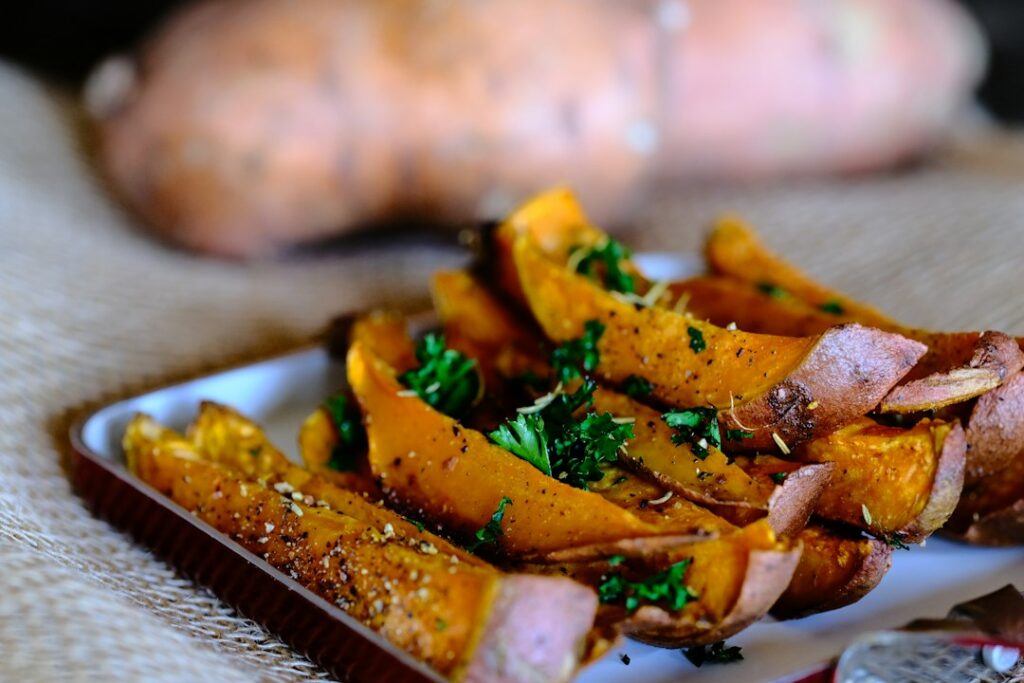
Yes, sweet potato is low FODMAP in a sensible portion. Monash University says ½ cup, or 75 g (about 2.65 oz), is low FODMAP. Servings over 100 g contain moderate amounts of mannitol, a sugar alcohol, and over 112 g are high, which can cause gas and bloating with IBS.
In this article
- Is sweet potato low FODMAP?
- What is mannitol and why does it matter for IBS?
- How much sweet potato can you eat with IBS?
- Is sweet potato good for your gut?
- Does cooking sweet potato change how it affects you?
- How can you enjoy sweet potato on a low FODMAP diet?
- Frequently asked questions
- What I want you to remember
Sweet potato is one of the few vegetables where a few spoonfuls change the answer. Monash University found that half a cup is low FODMAP. Go past about 100 g and it starts to carry a sugar alcohol that can upset IBS.
So is sweet potato low FODMAP? Yes, in a sensible portion. Here I explain the safe amount, why bigger portions cause trouble and how to enjoy it with IBS.
Is sweet potato low FODMAP?
Yes, sweet potato is low FODMAP at a standard serve of ½ cup, or 75 g (about 2.65 oz). Monash University, the team that created the low FODMAP diet, gives this amount a green light. Its 2025 low FODMAP shopping list gives the same 75 g serve.
Larger portions are a different story. In a 2016 blog, Monash research dietitians explained that servings larger than 100 g (about 3.5 oz) contain moderate amounts of mannitol. Servings over 112 g (about 4 oz) are high in mannitol.
Serving sizes can change after new lab tests. Please check the Monash app for the latest amounts before you plan big portions.
What is mannitol and why does it matter for IBS?
Mannitol is a polyol, a type of sugar alcohol found naturally in some vegetables. It is the P in FODMAP. Your small intestine absorbs it slowly and only in part, so some reaches the colon.
There, gut bacteria ferment it and it draws water into the bowel. In people with a sensitive gut, that can mean gas, bloating, pain or loose stools.
A 2014 Monash trial tested this directly. Researchers gave 20 people with IBS and 21 healthy people 10 g of mannitol, sorbitol or glucose on different days. Neither the volunteers nor the researchers knew which drink was which.
Gut symptoms rose after both polyols, but only in the people with IBS. Here is the surprising part. Symptoms rose whether or not their bodies absorbed the polyol well. The authors concluded that cutting back on polyols may help people with IBS.
The same study found that mannitol was higher in certain vegetables, while sorbitol was higher in certain fruits and sugar-free gum. My guide to sorbitol and IBS covers the other common polyol.
How much sweet potato can you eat with IBS?
Start with ½ cup, or 75 g (about 2.65 oz), per meal. Weigh it once so you learn what it looks like on your plate.
What about several low FODMAP foods at once? Monash calls this FODMAP stacking. Its dietitians say you should feel comfortable eating reasonable portions of green light foods together in one sitting. Most people will not get symptoms from that.
Monash gives a useful example. A soup made only of this vegetable is unlikely to be well tolerated if you eat 2 cups of it. Bulk it out with parsnip, potato and carrot, and it becomes a low FODMAP soup.
Try this
- Mix your mash. Make it half and half with regular potato. Monash lists potato, carrot and parsnip as low FODMAP at a standard serve too.
- Roast a tray of mixed vegetables. Combine small cubes of it with carrot, parsnip and courgette (zucchini), so each serving holds only a little of each.
- Flavour without onion and garlic. Use olive oil, chives, cinnamon, paprika, rosemary or garlic-infused oil.
- Keep a note. If you feel bloated after a meal, write down the portion. It helps you find your own limit.
Is sweet potato good for your gut?
Yes, it brings fibre and plant compounds that your gut bacteria can use. I strongly believe gut health plays a major role in nearly every health condition, and simple whole foods like this one matter.
According to USDA data, 100 g (about 3.5 oz) of baked sweet potato has 3.3 g of fibre. It also has 961 micrograms of vitamin A, mostly from beta carotene. That gives the flesh its orange colour.
Lab studies hint at a prebiotic effect. In a 2021 study, digested flours from 4 varieties were mixed with human gut bacteria for 48 hours. They raised Bifidobacterium and Lactobacillus and increased short-chain fatty acids. This was a lab test, not a trial in people.
Human trials are small. In a 2016 Chinese trial, 120 people with leukaemia having chemotherapy were split into two groups. Those who ate 200 g (about 7 oz) of it a day had less constipation. A 2012 trial in 93 heart patients combined it with footbaths and acupressure, so its effect cannot be credited to the food alone.
Note that 200 g is well above the low FODMAP portion. That amount may be too much if mannitol bothers you. These trials were not in people with IBS.
Why variety matters on a low FODMAP diet
The low FODMAP diet works for many people. A 2022 review in Gut ranked it first among the diets tested for IBS symptoms. But a strict version can lower friendly gut bacteria. A 2022 review in the American Journal of Clinical Nutrition found that it reduced Bifidobacteria in people with IBS. This is why the strict phase should be short.
It is also a good food for the reintroduction phase. A bigger test portion shows if you need to limit mannitol at all. My guide to the low FODMAP diet phases explains how to run each test.
Does cooking sweet potato change how it affects you?
Cooking method changes how fast it raises your blood sugar. In a 2011 Jamaican study, 10 healthy adults ate them cooked in different ways. Boiled ones had the lowest glycaemic index, 41 to 50.
Baked ones scored 82 to 94, and roasted scored 79 to 93. The study used local varieties, so results may differ for other types. If you watch your blood sugar, boiling or steaming is the gentler choice.
There is no good evidence that cooking method changes the FODMAP content in a way you can rely on. Stick to the portion, however you cook it.
How can you enjoy sweet potato on a low FODMAP diet?
Sweet potato fits breakfast, lunch and dinner in small amounts. Monash even publishes recipes for a sweet potato and feta frittata and a roasted quinoa bowl that uses it.
- Breakfast. A slice of that frittata with spinach. My low FODMAP breakfast ideas have more.
- Lunch. A bowl of quinoa, roasted cubes, rocket, feta and an olive oil dressing.
- Dinner. Grilled fish or chicken with a small scoop of the half and half mash.
- Holiday table. A small spoon of it next to plenty of plain potato and carrots. My low FODMAP Thanksgiving plan has a full menu.
Want to test what you know about safe and trigger foods? Try my Trigger or Safe game. For the bigger picture, my complete IBS diet guide covers what to eat, what to limit and how to find your triggers.
Frequently asked questions
How much sweet potato is low FODMAP?
Monash University says ½ cup, or 75 g (about 2.65 oz), of sweet potato is low FODMAP. Servings larger than 100 g contain moderate amounts of mannitol, and servings over 112 g are high. Check the Monash app for the latest serving sizes.
Is sweet potato better than regular potato for IBS?
Both can suit IBS. Monash lists both as low FODMAP at a 75 g serve. The orange one carries mannitol in larger portions, so if polyols bother you, regular potato is the easier choice for a big serving. Mixing the two works well.
Can sweet potato cause bloating?
Yes, a large portion can cause bloating in some people with IBS. Big servings are high in mannitol, which gut bacteria ferment into gas. In a 2014 trial, mannitol increased gut symptoms in people with IBS but not in healthy people.
Is sweet potato good for constipation?
Sweet potato has fibre, about 3.3 g per 100 g when baked. A 2016 trial in people having chemotherapy found that 200 g a day eased constipation. That portion is above the low FODMAP serve, and the trial did not include people with IBS.
What I want you to remember
Sweet potato is low FODMAP at ½ cup, or 75 g (about 2.65 oz). Above about 100 g, its mannitol can start to cause gas and bloating if you have IBS.
Mix it with potato, carrot and parsnip to enjoy more on your plate. Then test a bigger portion during reintroduction to learn your own limit. If you want a calm, guided reset for your gut, join my free 30-Day Calm Gut Challenge.
Sources
- Barrett J, Collins L. FODMAP stacking. Can I overeat green foods? Monash University FODMAP blog, 2016
- Valentine C. Low FODMAP shopping list. Monash University FODMAP blog, 2025
- Monash University. Sweet potato and feta frittata. Monash FODMAP recipes
- Monash University. Roasted sweet potato, quinoa and fried egg bowl. Monash FODMAP recipes
- Yao CK, et al. Dietary sorbitol and mannitol. Food content and distinct absorption patterns between healthy individuals and patients with irritable bowel syndrome. Journal of Human Nutrition and Dietetics, 2014
- USDA FoodData Central. Sweet potato, cooked, baked in skin, flesh, without salt (SR Legacy 168483)
- de Albuquerque TMR, et al. Effects of digested flours from four different sweet potato root varieties on the composition and metabolic activity of human colonic microbiota in vitro. Journal of Food Science, 2021
- Zou JY, et al. Improvement of constipation in leukemia patients undergoing chemotherapy using sweet potato. Cancer Nursing, 2016
- Ren K, et al. The effect of a sweet potato, footbath, and acupressure intervention in preventing constipation in hospitalized patients with acute coronary syndromes. Gastroenterology Nursing, 2012
- So D, et al. Effects of a low FODMAP diet on the colonic microbiome in irritable bowel syndrome. A systematic review with meta-analysis. American Journal of Clinical Nutrition, 2022
- Bahado-Singh PS, et al. Relationship between processing method and the glycemic indices of ten sweet potato cultivars commonly consumed in Jamaica. Journal of Nutrition and Metabolism, 2011
- Black CJ, et al. Efficacy of a low FODMAP diet in irritable bowel syndrome. Systematic review and network meta-analysis. Gut, 2022
This article shares general information. It is not a diagnosis or a treatment plan. Please talk to your own doctor before you change your diet, medicines or supplements.

Dt. Hashika Vyas
Hashika is a dietitian who works with clients in 15+ countries on gut health, PCOS and weight. She healed her own IBS, and writes every guide on this site to be calm, clear and practical.