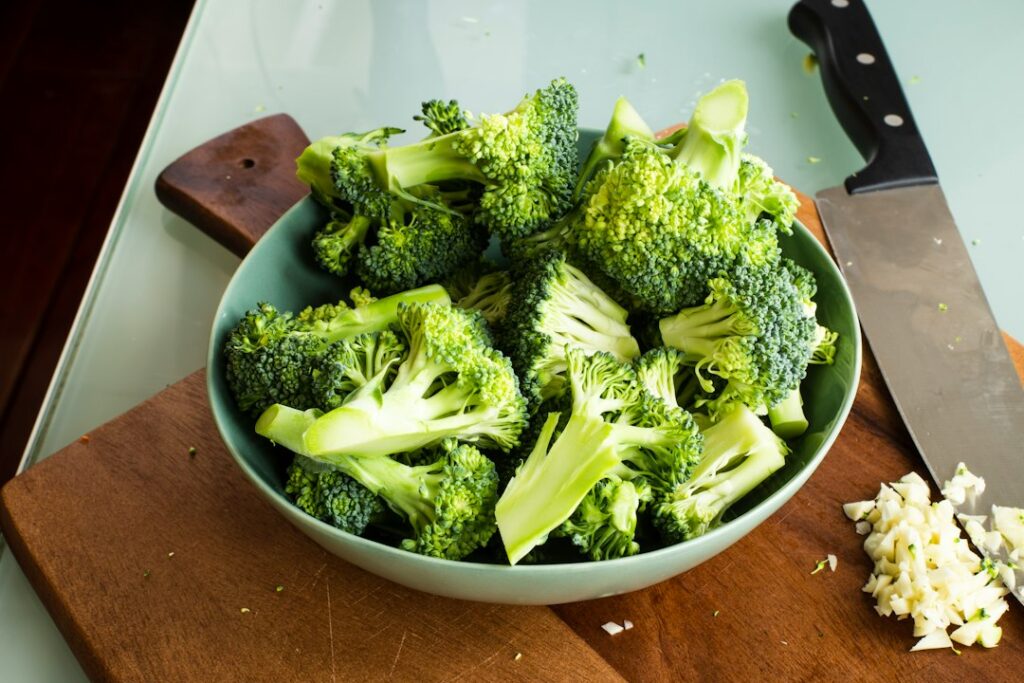
Yes, broccoli heads are low FODMAP. Monash University lists broccoli head as low at a standard 75 g (2.65 oz) serve. The stalks are richer in fructose and have a much smaller safe serve, reported at about 45 g. Choose mostly florets, keep stalks to a small handful and check the Monash app for the latest serves.
In this article
- Is broccoli low FODMAP?
- Broccoli heads vs stalks. Which is safer for IBS?
- Is broccolini or Chinese broccoli low FODMAP?
- Why does broccoli give some people gas?
- Is broccoli good for your gut?
- Does broccoli help constipation?
- Is broccoli healthy for everyone?
- How can you enjoy broccoli on a low FODMAP diet?
- Frequently asked questions
- What I want you to remember
Broccoli heads and broccoli stalks do not behave the same way in an IBS gut. Monash University lists broccoli heads as low FODMAP at a standard 75 g serve. The stalks are a different story.
So is broccoli low FODMAP? Yes, the heads are, in sensible portions. In this guide I explain heads vs stalks, broccolini and Chinese broccoli, how much to eat and what broccoli may do for your gut bacteria.
Is broccoli low FODMAP?
Yes, broccoli heads are low FODMAP. Monash University, the team that created the low FODMAP diet, lists broccoli head in its 2025 low FODMAP shopping list. It sits in the vegetable group that is low at 1 standard serve of 75 g (2.65 oz).
Monash keeps the full broccoli details, including stalks and larger serves, in its app rather than on its public pages. Lab results can change after new tests, so check the Monash app for the latest serve.
Broccoli heads vs stalks. Which is safer for IBS?
The heads are safer, and you can eat more of them. The stalks carry more fructose, a natural sugar that some people with IBS absorb poorly.
A 2024 guide by Karlijn Wever reports these figures from Monash testing.
- Broccoli heads. Low FODMAP at 75 g (about 3/4 cup). Moderate in fructose from 240 g (about 2 2/3 cups).
- Broccoli stalks. Low FODMAP at 45 g (about 1/3 cup). Moderate in fructose from 50 g.
So the gap for stalks is small. A few extra slices can tip you over. In my view, the easiest habit is to use mostly florets and keep stalks to a small handful.
Please treat these numbers as a guide. They are reported by a third party, not shown on a Monash public page, so check your own Monash app.
Is broccolini or Chinese broccoli low FODMAP?
Yes, both have low FODMAP serves, and they behave a little differently from regular broccoli. The same 2024 guide reports these Monash figures.
- Broccolini heads. Low at 58 g (about 2 oz). Moderate in fructose from 87 g.
- Broccolini stalks. Low at 90 g (about 3.2 oz). Moderate in fructans from 320 g.
- Chinese broccoli (gai lan). Low at 75 g (about 1 cup chopped). Moderate in fructans from 285 g.
Fructans are the same FODMAP found in onion and garlic. If you know fructans are your trigger, keep broccolini stalks and Chinese broccoli to modest portions.
Why does broccoli give some people gas?
It is rich in fibre, and gut bacteria ferment fibre and some sugars into gas. That gas is normal and part of a healthy gut. In a sensitive IBS gut, though, the stretch from gas can feel painful.
Which FODMAP bothers you is personal. A 2025 trial in Clinical Gastroenterology and Hepatology brought back each FODMAP group in turn. It followed 21 people with IBS who had improved on a low FODMAP diet. Fructans and galacto-oligosaccharides both made belly pain worse when brought back.
This shows why testing your own triggers matters. Not every FODMAP bothers every person. My guide to the 3 phases of the low FODMAP diet explains how to test them one at a time. For more on wind, read my guide to excessive gas.
Is broccoli good for your gut?
Yes, the research so far suggests broccoli feeds your gut bacteria in helpful ways. I strongly believe gut health shapes nearly every part of our health. This vegetable is a good example of a food that works through the gut.
A 2019 feeding trial included 18 healthy adults. They ate 200 g (about 7 oz) of cooked broccoli plus a little raw daikon radish daily for 18 days. Compared with a control diet, Bacteroidetes rose by 10% and Firmicutes fell by 9%. The effect was strongest in people with a lower body weight.
An older 2009 trial gave 17 adults a diet rich in cruciferous vegetables, such as broccoli and cabbage. Their gut bacteria changed in just 2 weeks. The response was different for each person.
How do your gut bacteria use broccoli?
It contains glucoraphanin. Your gut bacteria can turn it into sulforaphane, a plant compound researchers are studying for its effects on blood sugar and cell protection.
A 2025 trial in Nature Microbiology tested a broccoli sprout extract in 74 adults with prediabetes for 12 weeks. It did not meet its main goal for fasting blood sugar. But people who did respond had different gut bacteria, including a Bacteroides gene that helps make sulforaphane.
That trial used an extract, not whole broccoli, and the responder findings need to be confirmed. Still, it is a lovely reminder that what your gut bacteria do with food matters as much as the food itself.
Does broccoli help constipation?
It adds fibre, which helps keep stools regular, but it is not a proven constipation treatment on its own. According to USDA data, 100 g (3.5 oz) of boiled broccoli has 3.3 g of fibre.
A small 2018 study in Japan included 48 adults with constipation symptoms. They ate 20 g of raw broccoli sprouts or alfalfa sprouts a day for 4 weeks. Only the broccoli sprout group had better constipation scores. It was a small study, and sprouts are not the same as broccoli heads.
For proven steps, read my guide to IBS constipation. My guide to soluble vs insoluble fibre explains which fibre suits your gut.
Is broccoli healthy for everyone?
Yes, it is one of the most nutrient-rich vegetables you can eat. According to USDA data, 100 g (3.5 oz) of raw broccoli has just 34 calories, 89 mg of vitamin C and 2.6 g of fibre. It is also a good source of vitamin K.
It belongs to the cruciferous vegetable family. A 2025 review of 17 studies with 97,595 people linked eating more of these vegetables with a 20% lower risk of colon cancer. These were observational studies, so they show a link, not proof, and the authors urge caution.
One safety note. It is high in vitamin K, which affects blood clotting. If you take a blood thinner such as warfarin, ask your doctor or pharmacist before you change how much broccoli you eat.
How can you enjoy broccoli on a low FODMAP diet?
Stick to florets, keep to about 75 g (2.65 oz) per meal and pair it with other low FODMAP foods. Here are simple ideas.
- Roasted. Toss florets in olive oil, salt and lemon zest, then roast until the edges crisp.
- Stir fry. Cook florets with carrot, tofu or chicken, ginger and soy sauce, served over rice. My rice guide covers safe portions.
- With potatoes. Steam florets and serve with baked potato and a little cheese. Read my potato guide for more.
- Flavour without onion. Use garlic-infused oil, chives or the green tops of spring onions instead of onion and garlic.
Variety matters for your gut bacteria too. My guide to 30 plants a week shows how to add more plants without upsetting IBS. To test your food knowledge, play my Trigger or Safe game. For the full picture, read my complete IBS diet guide.
Frequently asked questions
Are broccoli stalks high FODMAP?
Broccoli stalks have a much smaller low FODMAP serve than the heads. A 2024 guide reporting Monash figures puts it at 45 g (about 1/3 cup), with moderate fructose from 50 g. Monash keeps the stalk details in its app, so check there and keep stalks to a small amount.
Is cooked broccoli easier to digest than raw?
Many people with IBS find cooked broccoli gentler, though no strong trial has compared the two for IBS. Cooking softens the fibre. The FODMAP serve is about portion size, so stay near 75 g of florets whether it is raw or cooked.
Is frozen broccoli low FODMAP?
Plain frozen florets are the same vegetable as fresh, so the same portion advice applies. Check the bag for added sauces or seasonings, which can contain onion or garlic. The freezer bag is a handy way to keep a low FODMAP vegetable ready.
Can I eat broccoli during a flare?
You can, in a small portion of well-cooked florets, if it normally suits you. During a bad flare, some people prefer softer vegetables such as carrots or courgette (zucchini) for a few days. My flare guide has more tips.
What I want you to remember
Broccoli heads are low FODMAP at a 75 g (2.65 oz) serve, and the stalks have a much smaller safe serve. Choose florets, keep stalks small and check the Monash app for the latest serves.
It is a gut-friendly food that feeds helpful bacteria, so I would not cut it out unless it clearly bothers you. If you want a calm, guided reset for your gut, join my free 30-Day Calm Gut Challenge.
Sources
- Valentine C. Low FODMAP shopping list. Monash University FODMAP blog, 2025
- Monash University. High and low FODMAP foods
- Wever K. Is broccoli low FODMAP? Karlijn's Kitchen, 2024 (reports Monash testing)
- Eswaran S, et al. All FODMAPs aren't created equal. Results of a randomized reintroduction trial in patients with irritable bowel syndrome. Clinical Gastroenterology and Hepatology, 2025
- Kaczmarek JL, et al. Broccoli consumption affects the human gastrointestinal microbiota. Journal of Nutritional Biochemistry, 2019
- Li F, et al. Human gut bacterial communities are altered by addition of cruciferous vegetables to a controlled fruit- and vegetable-free diet. Journal of Nutrition, 2009
- Dwibedi C, et al. Effect of broccoli sprout extract and baseline gut microbiota on fasting blood glucose in prediabetes. A randomized, placebo-controlled trial. Nature Microbiology, 2025
- Yanaka A. Daily intake of broccoli sprouts normalizes bowel habits in human healthy subjects. Journal of Clinical Biochemistry and Nutrition, 2018
- Lai B, et al. Cruciferous vegetables intake and risk of colon cancer. A dose-response meta-analysis. BMC Gastroenterology, 2025
- USDA FoodData Central. Broccoli, raw (SR Legacy 170379)
- USDA FoodData Central. Broccoli, cooked, boiled, drained, without salt (SR Legacy 169967)
This article shares general information. It is not a diagnosis or a treatment plan. Please talk to your own doctor before you change your diet, medicines or supplements.

Dt. Hashika Vyas
Hashika is a dietitian who works with clients in 15+ countries on gut health, PCOS and weight. She healed her own IBS, and writes every guide on this site to be calm, clear and practical.